Profit and Loss Statement Template: Free Downloads and a Fill-In Guide for 2026
A profit and loss statement template is the fastest way to answer the question every owner eventually asks: is this business actually making money, and where is it leaking. The statement itself is simple in shape: revenue at the top, the direct cost of what you sold next, then operating expenses, and net income at the bottom. What separates a useful statement from a decorated spreadsheet is discipline: consistent categories, a percent-of-revenue column, and a monthly cadence that survives busy seasons.
The four versions below cover the working life of the document: a monthly statement that tracks line items across the year, a variance version that compares budget and actual against last year, a quarterly summary for lender and tax conversations, and a one-page small business cut. All four are pre-filled with a fictional 40-seat bistro and a small online knit-goods brand, so the examples show real decision-making rather than placeholder rows.
Four profit and loss statement templates, free to download
Each version below is a working spreadsheet, not a blank grid with a title row. The fields are pre-filled with realistic example content from a fictional 40-seat bistro and a small online knit-goods brand, so you can see how a finished statement reads, then overwrite it with your own numbers. What you download is an everyday spreadsheet file, compatible with all the usual tools. No email address required.
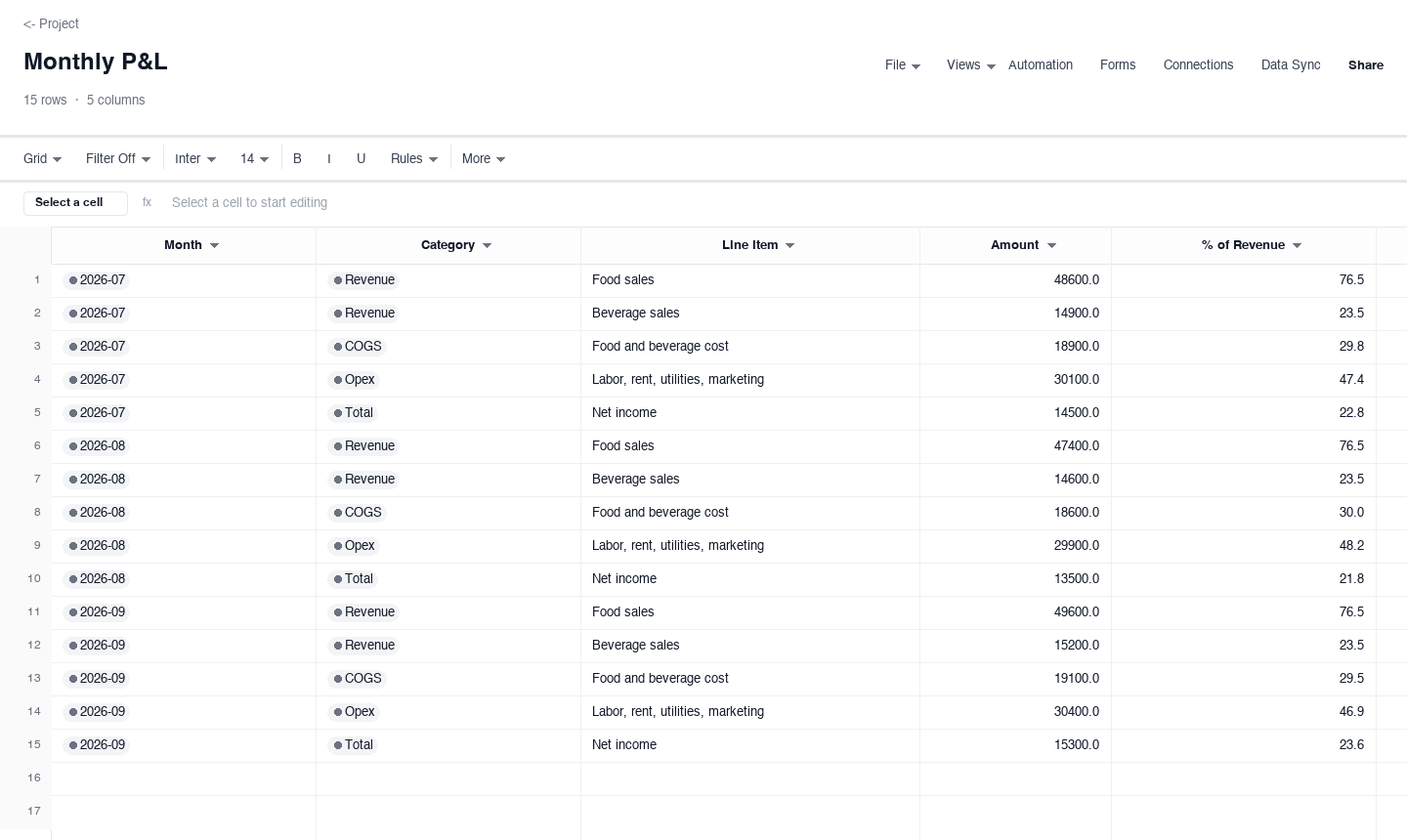
Monthly P&L
The monthly profit and loss statement is the working version of the statement: every revenue stream, cost of goods sold line, and operating expense gets its own row, each carrying its share of revenue. Use it when the question is whether the business model is holding, not only whether the month was busy. The percent-of-revenue column is the one to watch, because a cost line can drift a full point before the dollar total looks wrong.
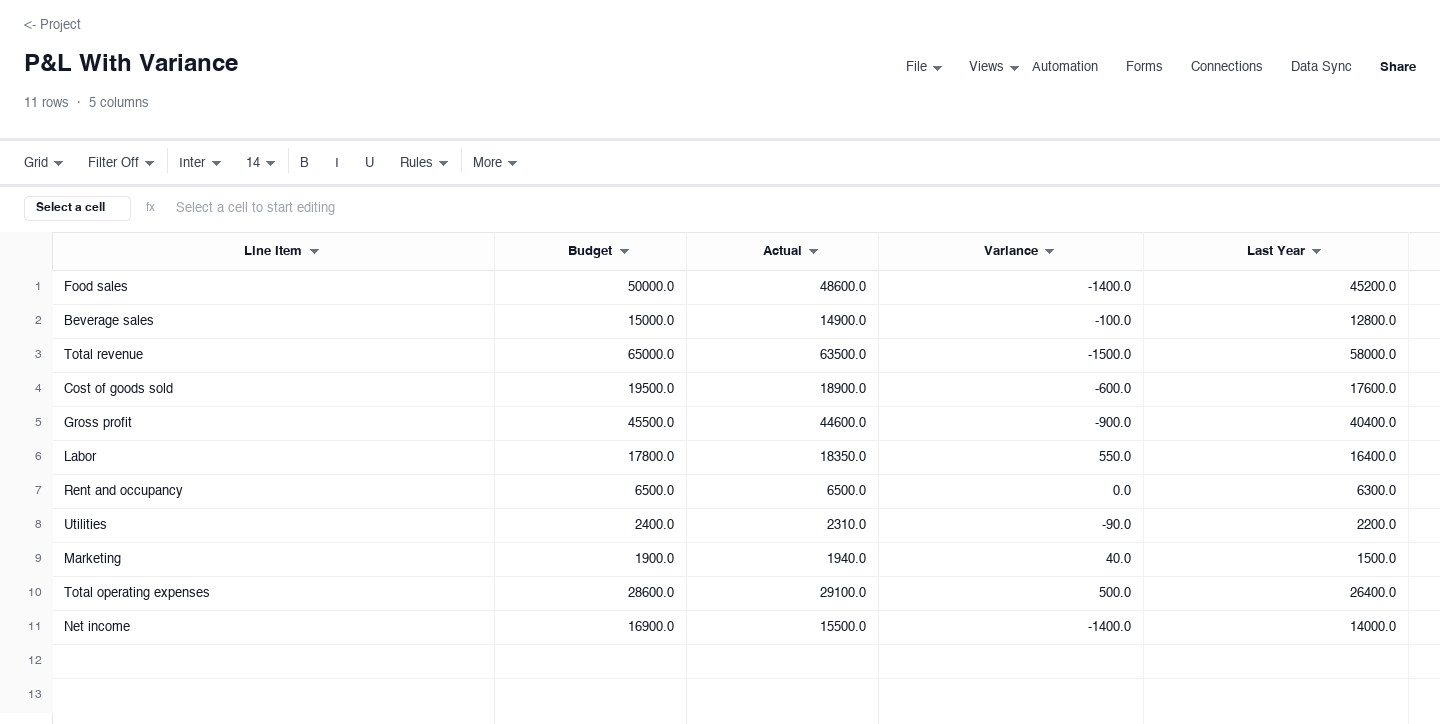
P&L With Variance
The variance version is for owners who plan: the same line items in four columns, budget, actual, the difference, and the same month last year. Use it after month close, when the raw numbers are known and the question is why they landed where they did. The variance column does the arithmetic so the conversation stays honest: a revenue line down 1,500 against budget reads differently next to labor up 550, and the sheet shows both at a glance.
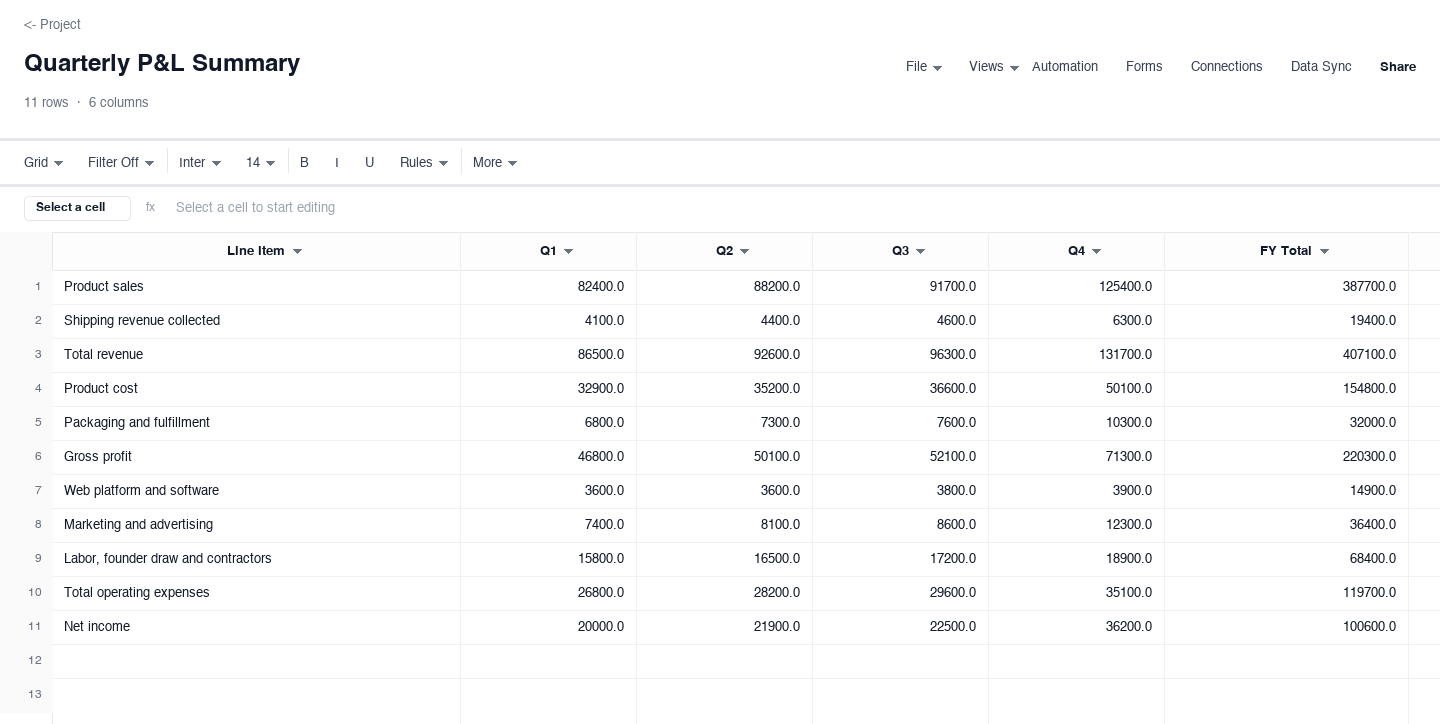
Quarterly P&L Summary
The quarterly summary compresses a year onto one screen: each line item across Q1 through Q4, with a full-year total column at the right. Use it for the conversations that do not need receipt-level detail: a bank check-in, a partner update, year-end tax prep with the accountant. The version above follows a small online knit-goods brand, and the holiday-weighted Q4 is the detail that earns its keep, because one strong quarter can carry a year and this layout shows that plainly.
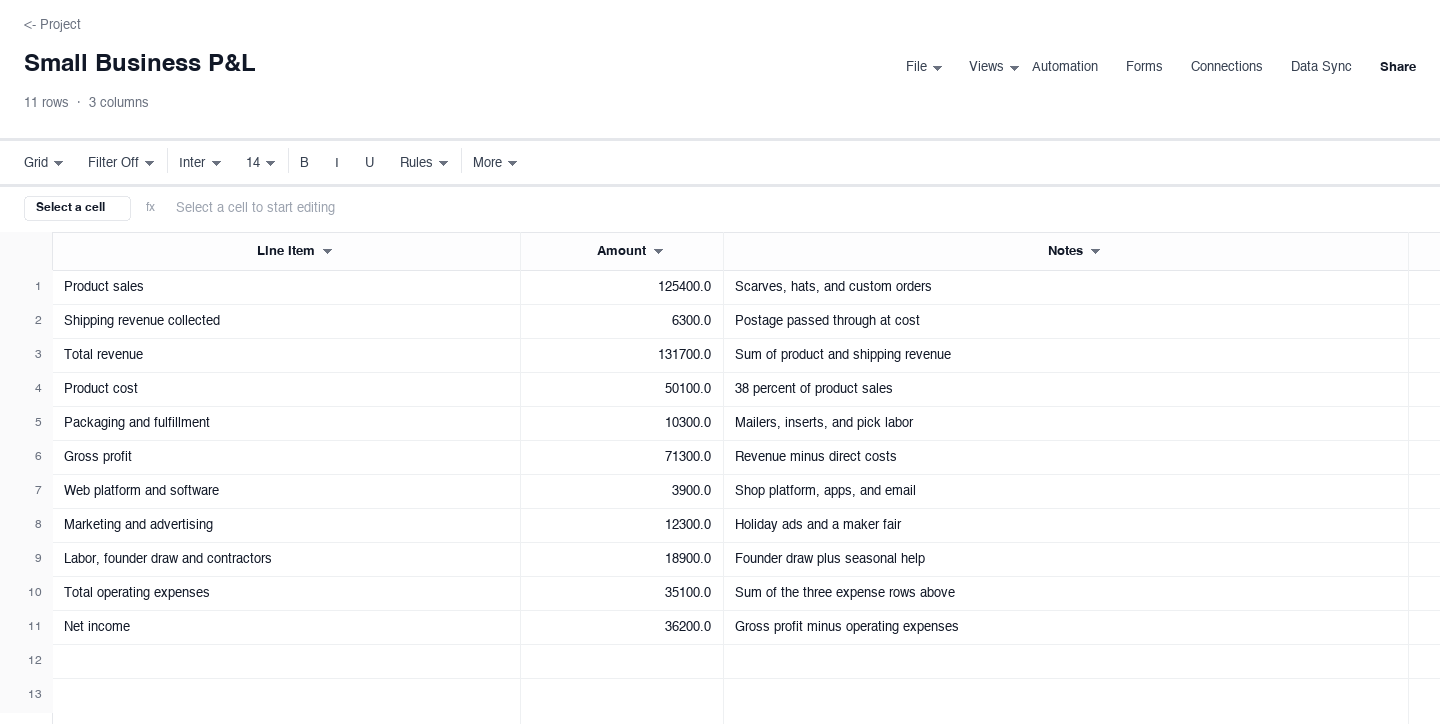
Small Business P&L
The small business version fits on one page: line item, amount, a short note. Use it when the company is small enough that one honest page beats a twelve-tab workbook, or as the page an owner sends the bookkeeper before the formal close. The example above shows one quarter of a knit-goods shop, and the notes column is the discipline that makes it work: "holiday ads and a maker fair" explains a marketing number in January that would be mysterious by spring.
How to build a profit and loss statement you will actually use
Split revenue into streams you can act on separately
One revenue line called sales tells you almost nothing. Break revenue into the streams the business actually manages: food and beverage for a restaurant, product and shipping income for an online seller, retainers and project fees for a firm. Two or three streams is right; ten is bookkeeping. The monthly variant above uses food and beverage for the bistro, because the two carry different margins and a single blended number hides which half of the menu is drifting. When a stream slips, the split tells you where to look the same week, not at year end.
Put cost of goods sold directly under revenue
Gross profit, revenue minus the direct cost of what you sold, is the first truth of the statement. Every line that belongs in cost of goods sold belongs there: ingredients, packaging, the freight to get finished goods to you, direct production labor. Costs that scale with sales belong above the gross profit line; costs that continue when sales stop do not. The monthly variant groups these as their own category rows, so food cost reads against food sales cleanly. Restaurants watch this as prime cost, food cost plus labor, and a two-point move there swallows a month of profit.
List every operating expense, including the small recurring ones
Below gross profit, list what it costs to run the business whether or not anything sold: rent, salaried people, utilities, insurance, software, marketing, the accountant. The leak is usually the four-hundred-dollar cluster: subscriptions, linen service, delivery app fees, equipment rentals, each too small to notice and together a full-time salary annually. Scan the card statement quarterly against this block of the sheet. Anything that cannot be named and justified in one sentence gets cancelled. The variance variant carries labor, rent, utilities, and marketing separately because those four decide most small businesses months.
Compute percent of revenue for every line, every month
Dollar amounts do not compare across months because revenue moves; percentages do. Divide each line by total revenue and keep the column visible. Food cost drifting from 29 to 31 percent is a story about suppliers or portioning; the same drift in dollars might look like growth. Set target ranges for the two or three lines that matter most and glance at the column before you read anything else. The monthly variant above ships with the percent column filled for a bistro third quarter, and the small business variant keeps the same discipline on a single page.
Compare against budget and last year, not just last month
A statement compared only to itself invites seasonality errors: September looks weak against August in a tourist town and strong everywhere else, and both readings are wrong. The variance variant puts budget, actual, the variance, and last year in four columns so the comparison set is always in view. Agree on the convention once, actual minus budget, and keep it, so a negative number means the same thing on every line. Then read the exceptions in order of absolute size, because the largest variance, favorable or not, is where the management time goes.
Reconcile net income to the bank account every month
Profit and cash part ways constantly: revenue counts when earned but arrives thirty days later, inventory is paid for ahead of sales, loan principal leaves the account without touching the income statement, and owner draws are not expenses at all. So when net income says one number and the account moved another, neither is wrong, and the exercise is explaining the bridge: receivables, payables, inventory, debt, draws. Walk it monthly until the differences become boring. The moment they stop reconciling is the moment the statement has a real error, and the monthly variants above are built to be reconciled, not just admired.
Is a profit and loss template the same as a profit loss statement template?
Yes, and the search data agrees: "profit and loss template", "profit loss statement template", and "profit and loss statement template" all describe the same document, a statement of revenue, costs, and profit over a period. The wording varies by region and by habit, with "P&L" doing the same work in accounting shorthand. The downloads on this page serve every one of those intents: the layout, the line items, and the math are identical regardless of which phrase brought you here.
If you compared three versions from three sources, the differences you would find are cosmetic: some put cost of goods sold in its own block, some fold everything below gross profit into a single operating section, and some show a percent-of-revenue column. None of that changes what the statement does. Pick the layout whose variants match how your business actually earns and spends, and ignore the label on the tin.
Profit and loss statement for small business
A small business does not need a bigger statement, it needs a shorter one. The small-business-p-and-l variant above is three columns on a single page: line item, amount, a note. That is enough for a food truck, a solo studio, or a two-person online shop to see the month clearly, and it is the version an owner can maintain between customers, not the twelve-tab workbook that gets abandoned by March.
The discipline that keeps a small-company statement honest is cadence, not complexity. Close the month within the first week: total the bank and card accounts, split revenue from the platforms you sell on, group costs into cost of goods, people, and overhead, and write the note that explains any line that moved more than you expected. Fifteen minutes a month on the compact version beats a perfect annual statement you cannot reconstruct.
Need a profit and loss statement template in Word or PDF?
Plenty of the people who ask for your numbers, a lender, a landlord, a franchisor, still expect a PDF, and some accountant workflows want a document rather than a sheet. The downloads above are .xlsx files by design, because a spreadsheet keeps totals computing and percent columns honest, but they convert cleanly: set the print area, export to PDF, and the statement reads exactly as laid out.
If someone specifically asked for a "profit loss statement template free pdf", this page is still the right stop. Download the variant that fits, overwrite the example rows with your own numbers, and export the PDF from the File menu. You keep one working spreadsheet as the source of truth, and every PDF you hand out matches it to the penny, because both came from the same file.
Frequently asked questions
What is a profit and loss statement?
A profit and loss statement is the financial report that summarizes revenue, costs, and expenses over a period of time, usually a month, quarter, or year, and lands on net income at the bottom. It is the same document accountants call an income statement. The monthly-p-and-l variant above shows the standard shape: revenue streams at the top, cost of goods sold, operating expenses, and the profit that remains.
How is a profit and loss statement different from a balance sheet?
The profit and loss statement covers a period and shows movement: what came in and what went out over the month or year. The balance sheet is a snapshot at one date: what the business owns, owes, and what belongs to the owners. The P&L feeds the balance sheet, because net income accumulates into retained earnings. The financial statement template page carries all three statements together, including the balance sheet this page does not cover.
How often should a small business prepare a profit and loss statement?
Monthly is the cadence that changes behavior, with a light weekly look at revenue and labor if the business has hourly staff. Monthly is frequent enough to catch a drifting food cost or a subscription pile-up while the cause is still findable, and it lines up with sales tax, payroll, and rent cycles. Quarterly and annual views still matter for tax and lenders, which is exactly what the quarterly-p-and-l-summary variant above is for.
Why does my profit and loss statement show a profit but the bank account is empty?
Because profit is an accounting measure and cash is a timing measure. Revenue counts when it is earned, not when the customer pays, so a profitable month can coincide with a thin bank account when receivables are outstanding, inventory was paid for ahead of sales, loan principal left the account, or the owner drew funds. The P&L is still right. The cash flow statement is the document that reconciles the two, and it is why the financial statement pack exists.
Can I get a profit loss statement template free PDF download?
Yes, indirectly and better: download any variant above as a free spreadsheet, fill in your own numbers over the example rows, and export it to PDF from the File menu. That gives you the PDF lenders and landlords expect while keeping a working version whose totals still compute. A PDF downloaded pre-filled with someone else numbers would need heavy editing anyway, so starting from the spreadsheet is the shorter path to the same page.
Do I need an accountant to prepare a profit and loss statement?
Not to produce a useful monthly statement. If your bank and card accounts reconcile and your categories are consistent, the template above plus an hour a month gets you a statement good enough to run the business on. You still want an accountant for the annual filing, entity structure, and the month where something strange happens, like a large inventory build or a loan restructuring. Many owners hand the accountant the monthly statements and cut the year-end bill sharply.
Run it live instead of in a file.
The downloads above are yours either way. In Wisegrid the same template becomes a working sheet with owner contacts, status dropdowns, reminders, and dashboards. 7-day free trial, no credit card required.