Financial Statement Template: Free Downloads and a Fill-In Guide for 2026
A financial statement template is the small company bridge between a shoebox of bank exports and the three documents the outside world eventually asks for: the income statement, the balance sheet, and the cash flow statement. Lenders, investors, landlords, and buyers all read the same trio, and they read it for direction: is profit growing, is the equity cushion thickening, is cash keeping pace with earnings. A template cannot do the accounting for you, but it forces the right structure onto your numbers.
The four versions below follow a fictional specialty foods manufacturer through its year-end close. There is a balance sheet that shows what the company owns and owes on one date, an income statement that shows what it earned over the period, a cash flow statement that explains where the cash moved, and a combined pack that lays the current period next to the prior one for all three. The examples are fully worked, so every tie-out is visible before you replace them with your own figures.
Four financial statement templates, free to download
Each version below is a working spreadsheet, not a blank grid with a title row. The fields are pre-filled with realistic example content from a fictional specialty foods manufacturer, so you can see how a finished statement reads, then overwrite it with your own details. What you download is an everyday spreadsheet file, compatible with all the usual tools. No email address required.
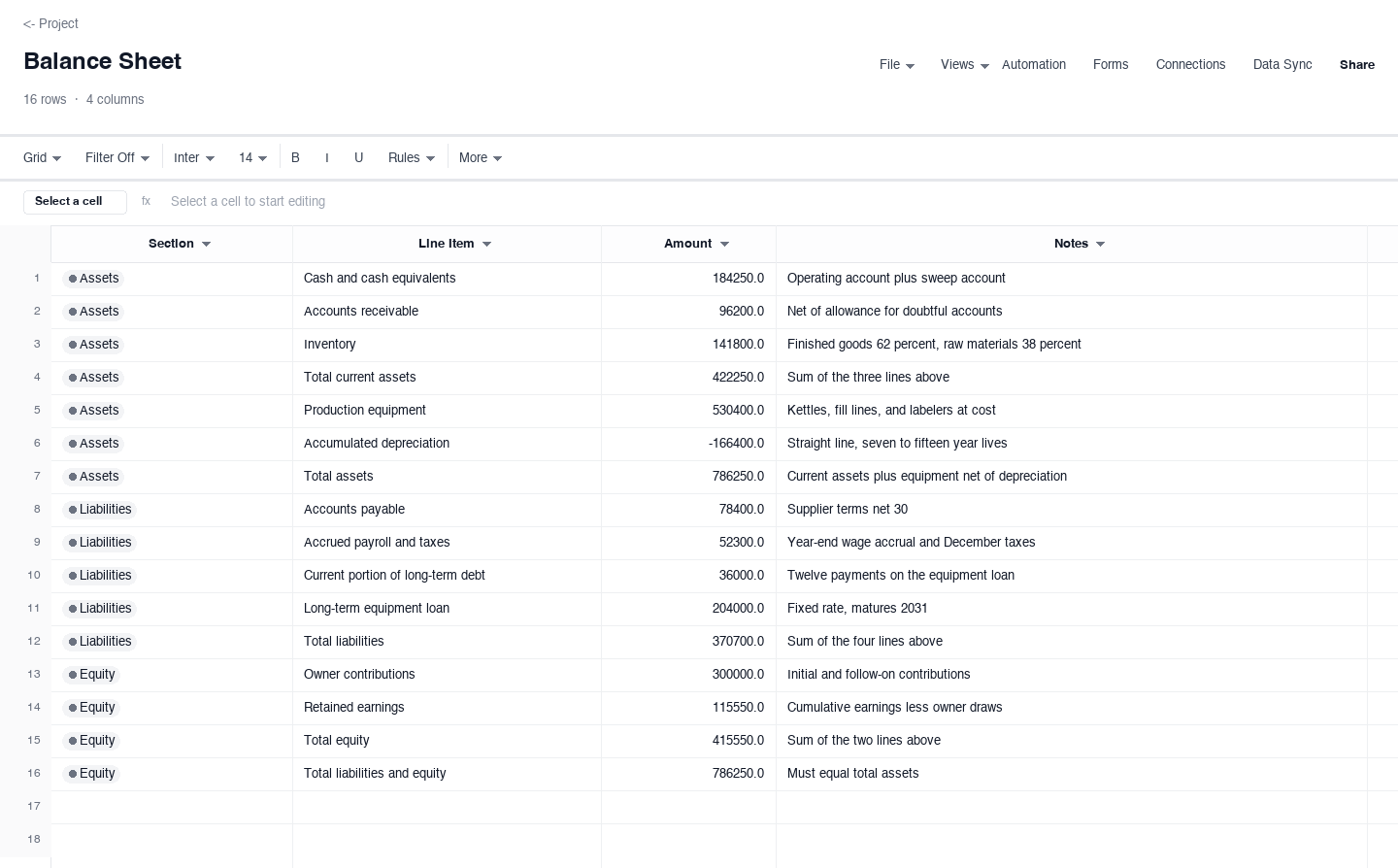
Balance Sheet
The balance sheet is the snapshot: what the company owns, what it owes, and what is left for the owners at one date. This version groups every line under assets, liabilities, or equity, with an amount and a note, and the sample follows a fictional specialty foods maker at year end. The note column is the habit that pays off, because "net of allowance" next to receivables reminds the reader what the number already absorbed.
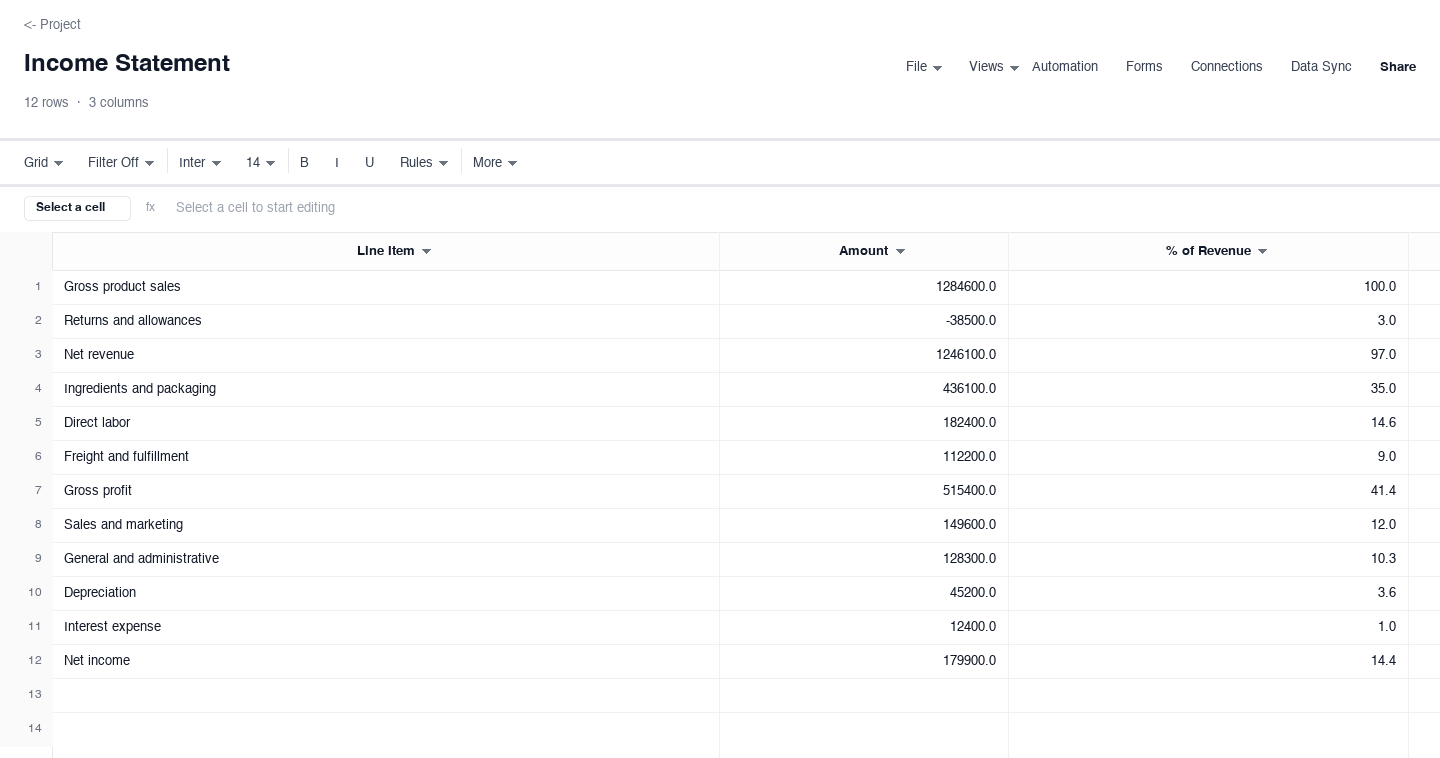
Income Statement
The income statement is the movie: revenue at the top, costs in the middle, profit at the bottom, each line with its percent of revenue. Use it to see whether the business earns money on what it sells before financing enters the story. The percent column is the one to read first, because a revenue line can grow ten percent while its share of the pie shrinks, and only the ratio column shows that happening in time to act.
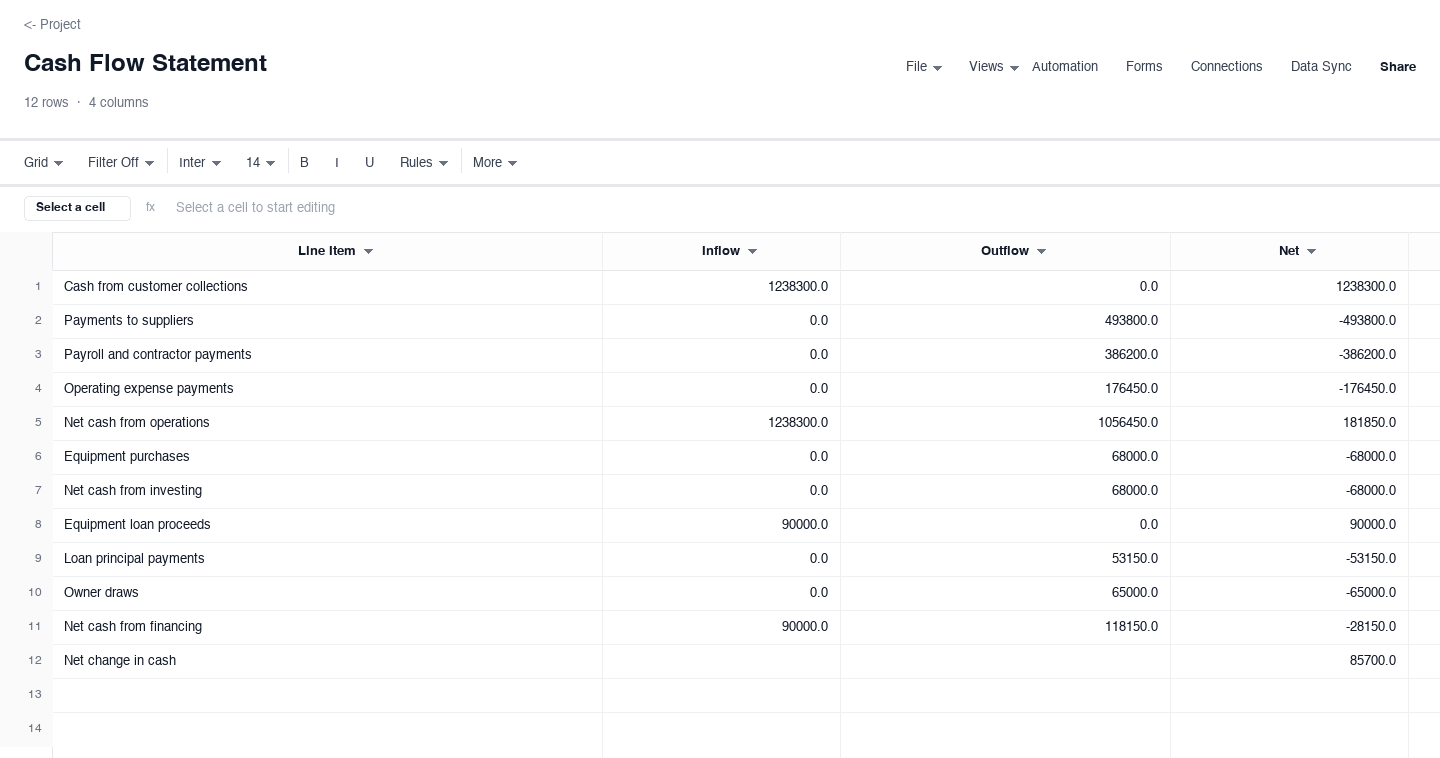
Cash Flow Statement
The cash flow statement answers the question the income statement cannot: where did the cash actually go. This version splits the period into operating, investing, and financing activities, with an inflow column, an outflow column, and the net per line. Use it when profit and bank balance disagree. The operating section is the part to read first, because a company can show net income while customer collections lag, and only this statement separates the timing story from the earning story.
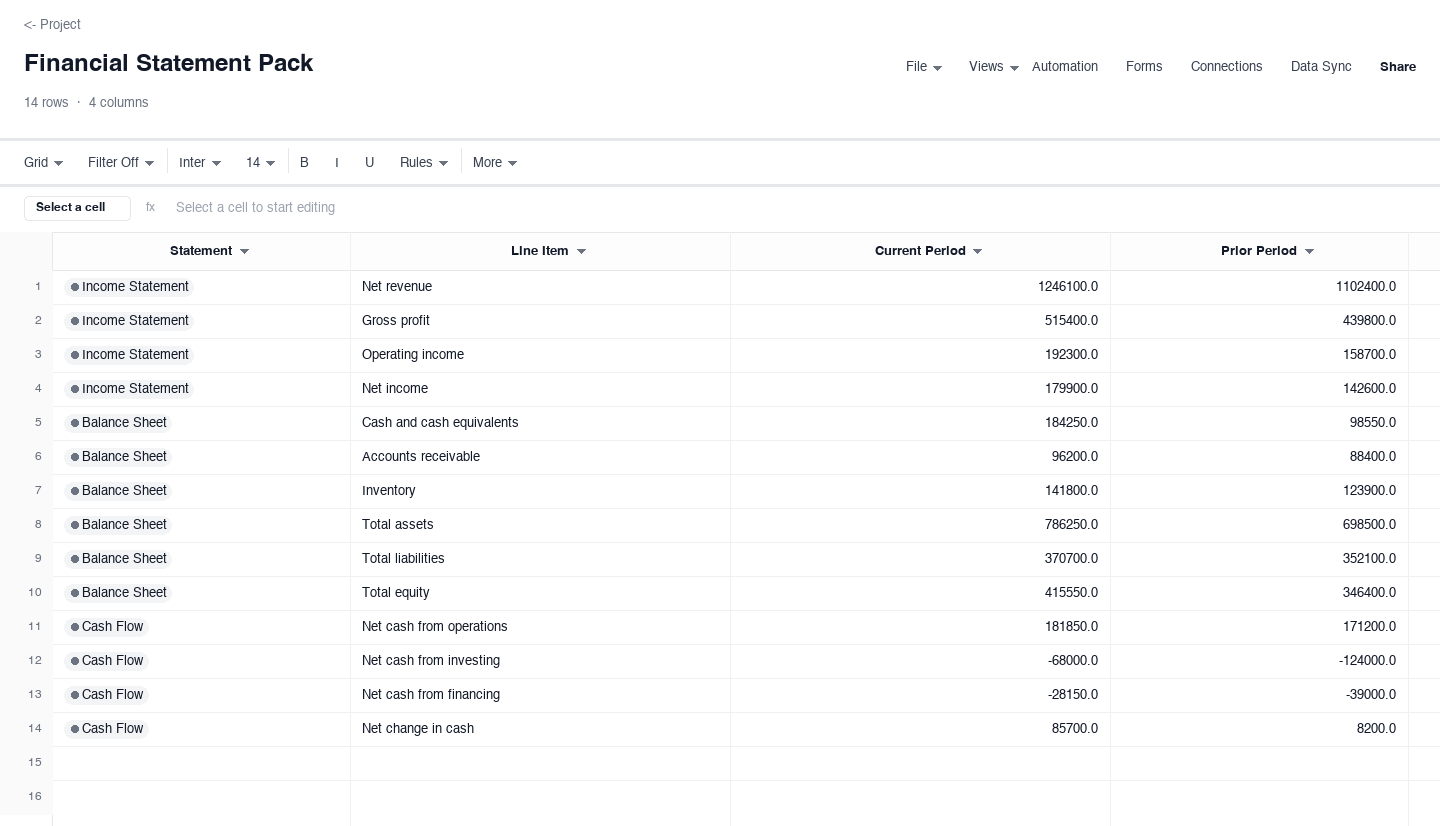
Financial Statement Pack
The pack is all three statements in one file, tagged by statement, with the current period next to the prior period on every line. Use it for the conversations that require the full picture: a bank review, a potential investor, or the annual sit-down with the accountant. The prior-period column is the feature that earns its keep, because a lender reads the direction of a number far faster than its size, and two columns hand over the direction instantly.
How to prepare a set of financial statements that hang together
Close the books before you write a single statement
Statements written on an open month produce confident nonsense. First reconcile every cash account to the bank statement, then accounts receivable to the invoice log, accounts payable to the supplier file, and inventory to a count or a perpetual record you trust. Post accruals: wages earned but unpaid, invoices for goods received but not billed, interest accumulating quietly. The close is done when the trial balance stops moving. A small manufacturer can close in two focused days; stretching it across three weeks guarantees adjustments nobody remembers. Everything after this step assumes the close held.
Start with the income statement, and respect the cutoffs
Revenue belongs in the period it was earned, not the period the invoice was sent or the cash arrived. Apply the same discipline to costs: the December shipment belongs in December even if the supplier bills in January. The income statement variant above runs revenue, direct costs, then operating expenses, with a percent-of-revenue column that turns the reading into ratios. Watch gross profit first; it is the largest honest number on the page, and the operating lines below it should explain themselves against it. If net income surprises you, the explanation is almost always a cutoff, not a miracle or a theft.
Build the balance sheet from the trial balance and make it balance
Every account in the trial balance lands somewhere on the balance sheet: cash and what will become cash go to assets, what the company owes goes to liabilities, the remainder goes to equity. Then the check that cannot be waived: total assets must equal total liabilities plus total equity, to the penny. An imbalance means a misclassified entry, a missing accrual, or a rounding shortcut taken somewhere upstream; the balance sheet variant above carries the full structure with notes on the lines people ask about. Never force a balance with a plug, because the plug becomes next year mystery.
Write the cash flow statement last, as the explanation of one line
The cash flow statement exists to explain the change in the balance sheet cash line, nothing more, and it is written after the other two. Start from net income, add back depreciation, which reduced income without touching cash, then adjust for the timing moves: receivables growing consume cash, payables growing provide it, inventory builds consume it. The variant above uses the direct presentation, actual collections and payments, which lenders find easier to read. The moment the ending cash figure agrees with the balance sheet, the three statements are tied together, and the set is internally consistent.
Put the current period beside the prior period on every line
A number without a comparison is a fact; with one, it is a finding. The statement pack variant lays the current period next to the prior on every line of all three statements, because readers, lenders first among them, judge direction before size. Compute the change and the percent change for the lines that matter, revenue, gross profit, cash, debt, equity, and ask what story the pair tells. A twenty percent revenue rise with flat cash is a different company than the reverse, and both deserve different questions at the bank.
Keep the notes on the face of the statements, not in email
Every statement carries lines whose numbers need one sentence of context: an allowance against receivables, a loan maturity, what the inventory split is. Put those sentences in the notes column on the sheet itself, as the balance sheet variant does, so the context travels with the file. Context buried in email evaporates exactly when needed, which is months later, with a new reader. The discipline also disciplines the author: a note you cannot write simply is usually a line you do not fully understand, and that is worth knowing before the lender asks.
Need a small business income statement template?
That is one of the four variants above, the income statement, and it is built for exactly that job: revenue, cost of goods sold, operating expenses, and net income, each line with its percent of revenue. A small business does not need a different kind of income statement than a large one, only fewer lines and a monthly cadence it can actually keep. If you want the plain-language walkthrough of every line, the profit and loss statement template page goes deeper on the same document.
The practical advice for a first income statement is to keep it short enough to finish. Group expenses into three or four buckets rather than thirty accounts, compute the percent-of-revenue column every month, and let the ratios tell you where to dig. A statement you close by the tenth of the following month teaches you something; a perfect statement finished in March about January does not.
Is a financial spreadsheet for small business the same as a financial statement?
Close cousins, not synonyms. A financial spreadsheet for small business is the working file: the budget, the cash tracker, the close checklist, sometimes all in one workbook. A financial statement is a formal output drawn from that work: the income statement, the balance sheet, the cash flow statement. The spreadsheet is the kitchen; the statements are the plated dish. The financial-statement-pack variant above is the plated version, one line per figure, current period against prior.
The handoff between the two matters more than the terminology. When a lender or investor asks for financials, they want the statements, not the working file. Keep the messy spreadsheet private, reconcile it monthly, and export the three statements from it. If your working file is tidy enough that the statements fall out of it with an hour of effort, you have the right setup, whatever you call it.
Frequently asked questions
What are the three main financial statements?
The income statement, which reports revenue and profit over a period; the balance sheet, which reports assets, liabilities, and equity at a single date; and the cash flow statement, which reports where cash actually moved, split into operating, investing, and financing activities. Together they answer: did we earn anything, what do we have, and where did the cash go. The financial-statement-pack variant above collects all three in one file.
What is the difference between an income statement and a profit and loss statement?
There is no difference; they are two names for the same document, with profit and loss or P&L the common small-business phrasing and income statement the formal accounting term. Both run revenue at the top, costs below, and profit at the bottom over a defined period. The dedicated profit and loss page covers the same statement with restaurant and e-commerce examples if you want a second angle on it.
How do the three financial statements connect to each other?
Net income from the income statement flows into equity on the balance sheet as retained earnings, and the balance sheet must always balance: assets equal liabilities plus equity. The cash flow statement then explains the change in the cash line on the balance sheet, starting from net income and adjusting for non-cash items and timing. When the three agree with each other, the set is internally consistent, and that is the first thing a lender checks.
Do lenders really ask for all three financial statements?
For any meaningful amount, yes. A bank extending a term loan or line of credit will ask for the income statement to see earning power, the balance sheet to see what secures the debt and what cushion exists, and the cash flow statement to see whether the business generates the cash to service payments. Historical statements for two or three years plus a current period is the usual ask, which is why the pack variant carries current and prior columns side by side.
Can a financial spreadsheet for small business replace accounting software?
For a very small business, a disciplined spreadsheet can carry the first year or two: reconciled bank lines, categorized expenses, and the three statements exported monthly. Past that point, sales tax, payroll, inventory, and audit trail push most companies toward real software, and the spreadsheet becomes the planning layer on top. The balance sheet and cash flow variants above are honest about their limits: they report the close, they do not run it.
How often should a small business prepare financial statements?
Monthly, closed within the first week or two of the following month, is the cadence lenders and serious operators expect. Monthly statements catch problems while the cause is still traceable: a margin slip, a receivable aging past terms, a cost line that crept. Quarterly statements satisfy most covenant and tax-projection needs, and the annual set goes to the accountant. The cash flow statement can run slightly less often if cash is comfortable, but never less than quarterly.
Run it live instead of in a file.
The downloads above are yours either way. In Wisegrid the same template becomes a working sheet with owner contacts, status dropdowns, reminders, and dashboards. 7-day free trial, no credit card required.