Cash Receipt Template: Free Downloads and a Fill-In Guide for 2026
A cash receipt template is the small document that proves money changed hands: who paid, who received, how much, for what, on what date, and by what method. Cash has no statement to check later, which is exactly why the receipt exists. Market vendors, landlords collecting rent in person, fundraiser tables, and anyone paid outside an invoicing system all need the same few fields filled in correctly, because the receipt is often the only record either side will ever have.
A receipt is not an invoice and it is not a pay stub. An invoice asks for money before payment happens; a receipt acknowledges money after it arrives. That distinction sounds obvious, but losing it costs people: a worker who needs proof of income cannot use a receipt, and a tenant who paid in cash has nothing without one. The versions below cover the four situations where the paper trail matters most: a single sale, a season of sales, a rent payment, and a donation.
Four cash receipt templates, free to download
Each version below is a working spreadsheet, not a blank grid with a title row. The fields are pre-filled with realistic example content from a farmers-market vendor and a small landlord so you can see how a finished receipt reads, then overwrite it with your own details. What you download is an everyday spreadsheet file, compatible with all the usual tools. No email address required.
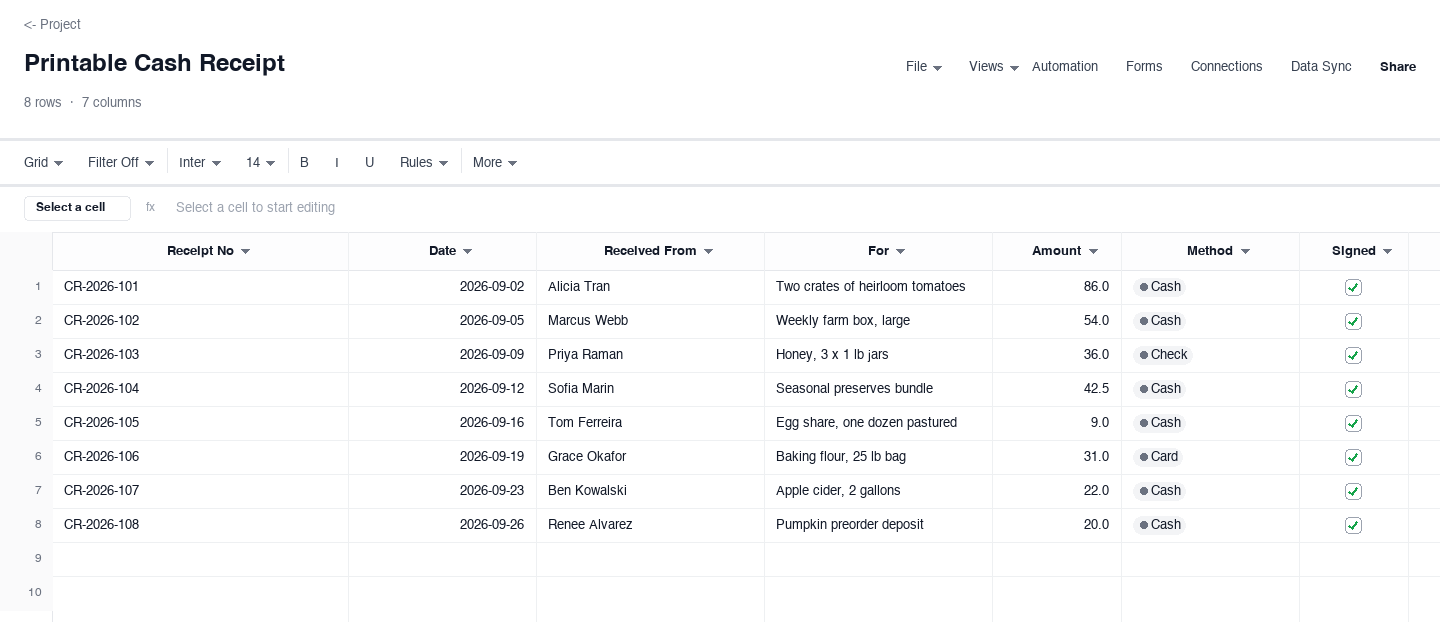
Printable Cash Receipt
The printable cash receipt is the single-sale version, filled out at the moment money changes hands and signed on the spot. Each row carries a receipt number, the date, who paid, what the payment was for, the amount, and the method, plus a signature flag confirming the slip was actually signed. It suits market stalls, farm stands, and deposit collections anywhere a sale happens away from a register. The signature flag earns its keep the day a buyer disputes a cash payment and the signed slip ends the argument.
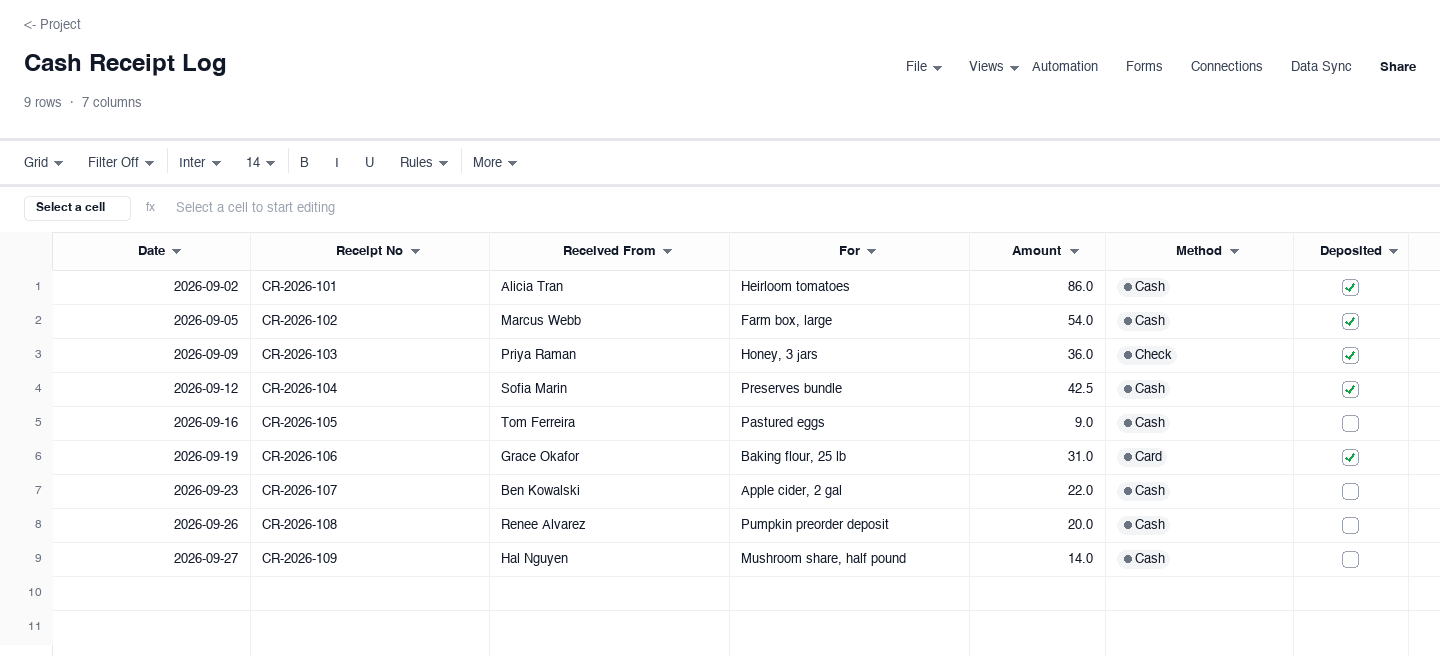
Cash Receipt Log
The cash receipt log is the backup register for a whole season of sales: one row per receipt or till batch, with the date, receipt number, where the money came from, the amount, the method, and a deposited flag. Use it alongside the printable version so paper slips are not the only record of cash income. The deposited flag is the control that earns its keep: mark each entry when its cash reaches the bank, and the unmarked rows are exactly the cash still sitting in the drawer.
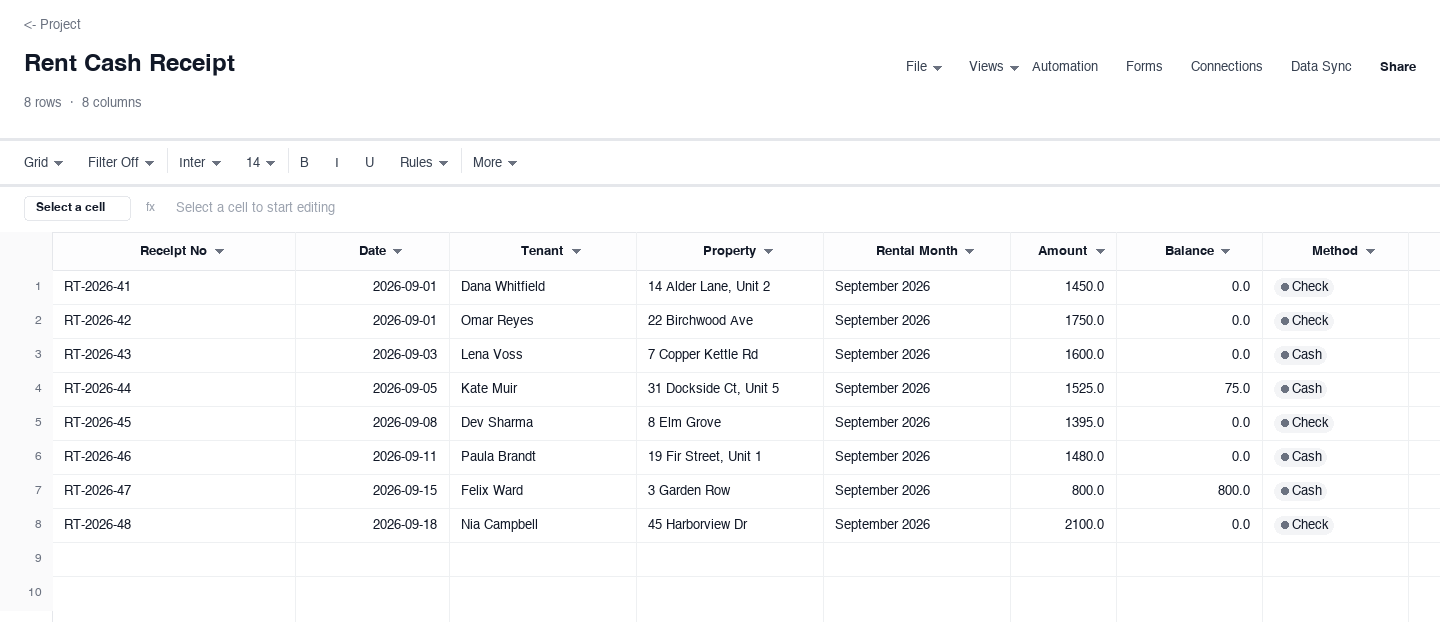
Rent Cash Receipt
The rent cash receipt is written from the landlord side when a tenant pays in cash or by any method that leaves no automatic record. Each row names the tenant, the property, the month the payment covers, the amount received, the balance still owed, and the method. Use it for every unit in the building so the rent history lives in one place instead of a box of carbon copies. The balance column is the feature that earns its keep in October, because it shows at a glance which tenant still owes part of September.
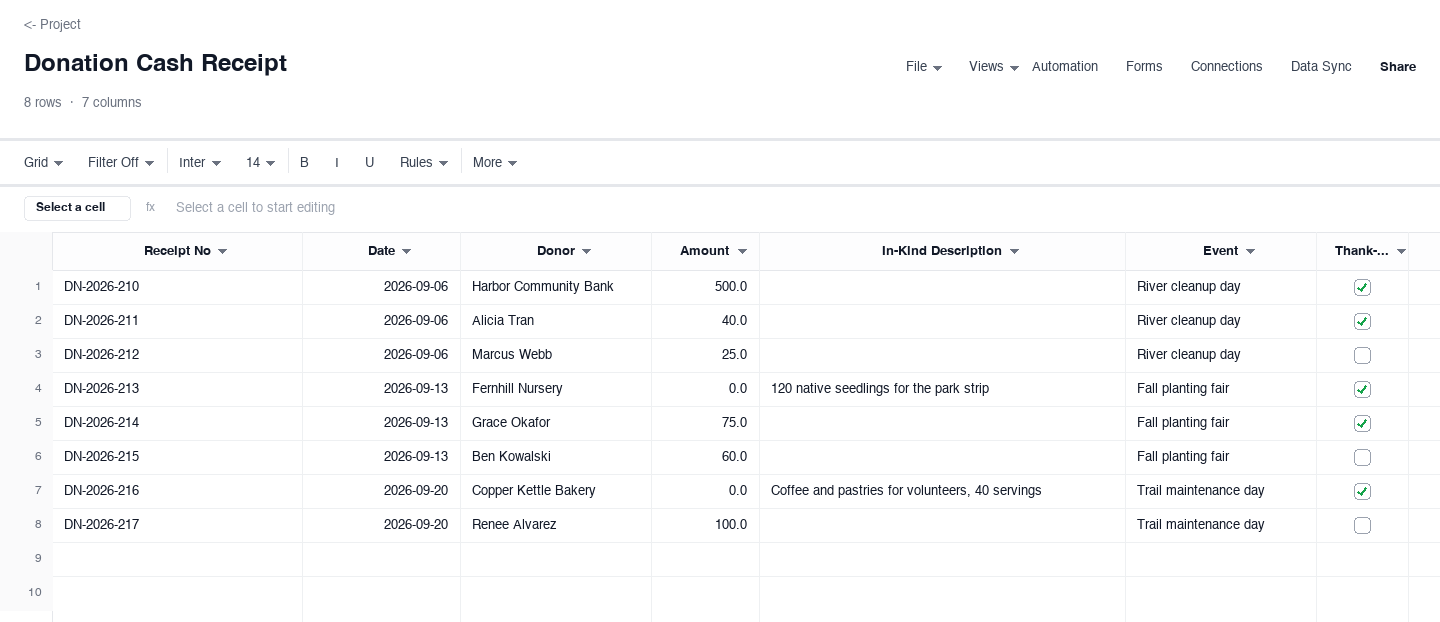
Donation Cash Receipt
The donation cash receipt is for the volunteer table at a fundraiser, a food pantry, or a community collection, where money and goods arrive at once and the thank-you notes otherwise never happen. Each row records the donor, the date, the amount, an in-kind description for goods instead of cash, and a thank-you flag. The flag is the small control that earns its keep: donations are goodwill, and a logged thank-you makes sure the goodwill is answered before the next event.
How to write a cash receipt that settles questions before they start
Number every receipt once, in one unbroken sequence
The receipt number is how two people land on the same slip weeks later, so pick a scheme and never reuse one, even for a receipt that was voided. A prefix plus a running number, like CR-1041, works for a market vendor and for a landlord alike. Never tear out a botched receipt and move on: mark it VOID, keep it in the book, and issue the next number. A sequence with unexplained gaps reads like missing money, and the whole point of the number is that nobody has to wonder whether a receipt disappeared.
Fill it out while the customer is still standing there
End-of-day memory is how amounts get rounded and names get spelled wrong. Write the receipt at the moment the money moves: the full name of who paid, what the payment was for, the amount counted back, and the method. For a check, note the check number on the receipt itself, not on a sticky note. If the buyer wants a company name or a unit number on the receipt, add it then, because a receipt corrected later looks exactly like a receipt written later, and that is the argument you are trying not to have.
Write what the payment was for in plain words
The for field is the one that settles the later dispute, so describe the goods or the service the way the buyer would: two flats of heirloom tomatoes, October rent for unit 2, deposit on a pumpkin preorder. One vague word like items or stuff makes the receipt weak evidence, because anyone can claim anything filled that space. If the payment covers a balance, say so: deposit, balance, or final payment. When the description matches the buyer memory and the seller log, the receipt rarely gets argued with at all.
Record the method next to the amount
A receipt that says 40 dollars without saying how tells you less than you think, because the follow-up question is always the same: where is it now? Log cash, card, check, or mobile next to every amount, and count cash twice before you write it. If you take payment apps, note the transfer reference on busy days. The method column is what lets you reconcile the log against the bank deposit later, and a deposit that does not match the methods on the receipts is a question to answer the same day.
Get the signature before anyone walks away
The signature turns a note into an acknowledgment. On the printable version the signature flag records that the slip was actually signed, and for rent the stronger habit is initials from both parties on the landlord copy. An unsigned receipt is not worthless, but it is weaker, because the payer can claim they never saw it. Make signing part of the handover, the same way a card terminal asks for confirmation before the transaction closes, and the habit costs nothing once it is automatic.
Log every receipt and reconcile weekly
The log is the register behind the slips: one row per receipt or till batch, with the date, number, source, amount, method, and a deposited flag. Mark each row when its cash reaches the bank, then compare the unmarked rows against the cash actually in the drawer. Ten minutes a week answers the three questions that matter: did every receipt get written, did every dollar get deposited, and does the bank agree. The vendors who lose cash almost always skipped the log, not the receipt.
Need a pay stub example PDF instead?
If you searched for a pay stub example PDF and landed here, the receipt is probably not the document you need. A pay stub is an employer document: it lists hours, pay rate, gross wages, each deduction, and net pay for a specific pay period, and workers use it as proof of income. A cash receipt records money already received between two parties and carries none of those wage or tax fields, so it will not satisfy an apartment application, a loan file, or any form that asks for proof of earnings.
The distinction matters most when someone gets creative under pressure. A worker paid in cash who needs income proof should ask the employer for real pay stubs, not write receipts to themselves, and an employer handing out cash wages owes proper payroll records, not a stack of receipts. If a receipt is genuinely what you need, the printable version above covers a single payment; for wages, look for a pay stub template that carries pay period, hours, rate, gross pay, deductions, and net pay, and keep it separate from the receipt book.
Frequently asked questions
What is the difference between a cash receipt and an invoice?
An invoice comes before the payment and asks for it: it lists what is owed, from whom, and by when. A cash receipt comes after and acknowledges that money arrived. The same transaction can produce both, and often should: the invoice requests the payment, the receipt confirms it. If you only keep one, the receipt is the proof that matters in a dispute, which is why every version above carries a receipt number both parties can refer back to.
Can a handwritten cash receipt hold up as proof of payment?
Yes, if it carries the right fields: a unique receipt number, the date, the names of both parties, what the payment was for, the amount, the method, and a signature or mark of acknowledgment. What sinks handwritten receipts is vagueness: no number, no description, amounts in rounded figures that match nothing else. The printable version above structures all of this so every slip reads the same way, and the log version keeps the matching register on your side.
Is a cash receipt the same as a pay stub?
No, and confusing the two causes real problems. A pay stub is an employer document showing hours, rate, gross pay, deductions, and net pay for a pay period; it proves what you earned. A cash receipt proves that a payment was received and says nothing about wages or taxes. People searching for a pay stub example PDF sometimes land on receipt templates; if you need proof of income for an apartment or a loan, you need pay stubs from the employer, not a receipt you write yourself. The section above covers the difference in more detail.
Do I have to give a receipt for a cash payment?
For most small face-to-face sales there is no law requiring one, but some situations expect it: rent payments in cash, deposits of any kind, donations, and any transaction where the other party will need proof later. The cost of issuing one is under a minute, and the cost of not having one is arguing from memory. If you accept cash regularly, make the receipt automatic and numbered, because the dispute you prevent will almost never announce itself in advance.
How should I fix a receipt mistake?
Never throw a bad receipt away and never reuse its number. Mark the original VOID in large letters, keep it in the sequence, and issue the next number for the corrected receipt. The gap-free numbering is what makes your book credible, because anyone reading it later, a bookkeeper, a tax preparer, another landlord, can see that nothing was quietly removed. The log version above has room for this convention: a voided receipt stays as a row with a zero amount and a note.
What should a donation receipt include?
At minimum: the donor name, the date, the amount for a cash gift or a plain description for an in-kind one, and a record that thanks went out. In the United States, donors need written acknowledgment from the charity for any single gift of 250 dollars or more before they can claim the deduction, so the acknowledgment has to exist and be retrievable. The donation version above tracks a thank-you flag per gift so no donor is missed, which protects both the donor deduction and the charity goodwill.
Run it live instead of in a file.
The downloads above are yours either way. In Wisegrid the same template becomes a working sheet with owner contacts, status dropdowns, reminders, and dashboards. 7-day free trial, no credit card required.