Product Roadmap Template: One Sheet That Survives Every 2026 Roadmap Review
A product roadmap template is worth using only if it survives contact with the quarter. Slides do not: the deck drifts from reality within two sprints, and then every review starts with an hour of rebuilding the picture. A roadmap kept as a sheet is the opposite kind of artifact: one row per initiative, with its horizon, theme, owner, confidence and status, edited in thirty seconds when something changes, filterable when an exec asks what is shipping this quarter.
The three versions below are the three roadmap formats that actually get maintained: now-next-later for external and low-ceremony use, quarter-based for planning against capacity, and OKR-aligned for teams whose review keeps asking why is this on the list. Each one ships pre-filled with a believable B2B product roadmap, so you can see the format working before you swap in your own initiatives.
Try the roadmap live. No signup.
This is an editable sheet, not a picture of one. Move an initiative between horizons, flip a status, rewrite a problem statement. Edits stay in your tab and vanish when you leave. When you want a roadmap that keeps, one click makes it yours.
| Initiative | Horizon | Theme | Problem it solves | Confidence | Status |
|---|---|---|---|---|---|
Sandbox only, edits don't persist. Want to keep your work? Start your 7-day free trial →
Three product roadmap templates, free to download
Each download came out of the product exporter filled with a real-shaped roadmap rather than lorem ipsum in a grid. Open them in Excel or in whatever handles .xlsx. No email address is asked for on the way.
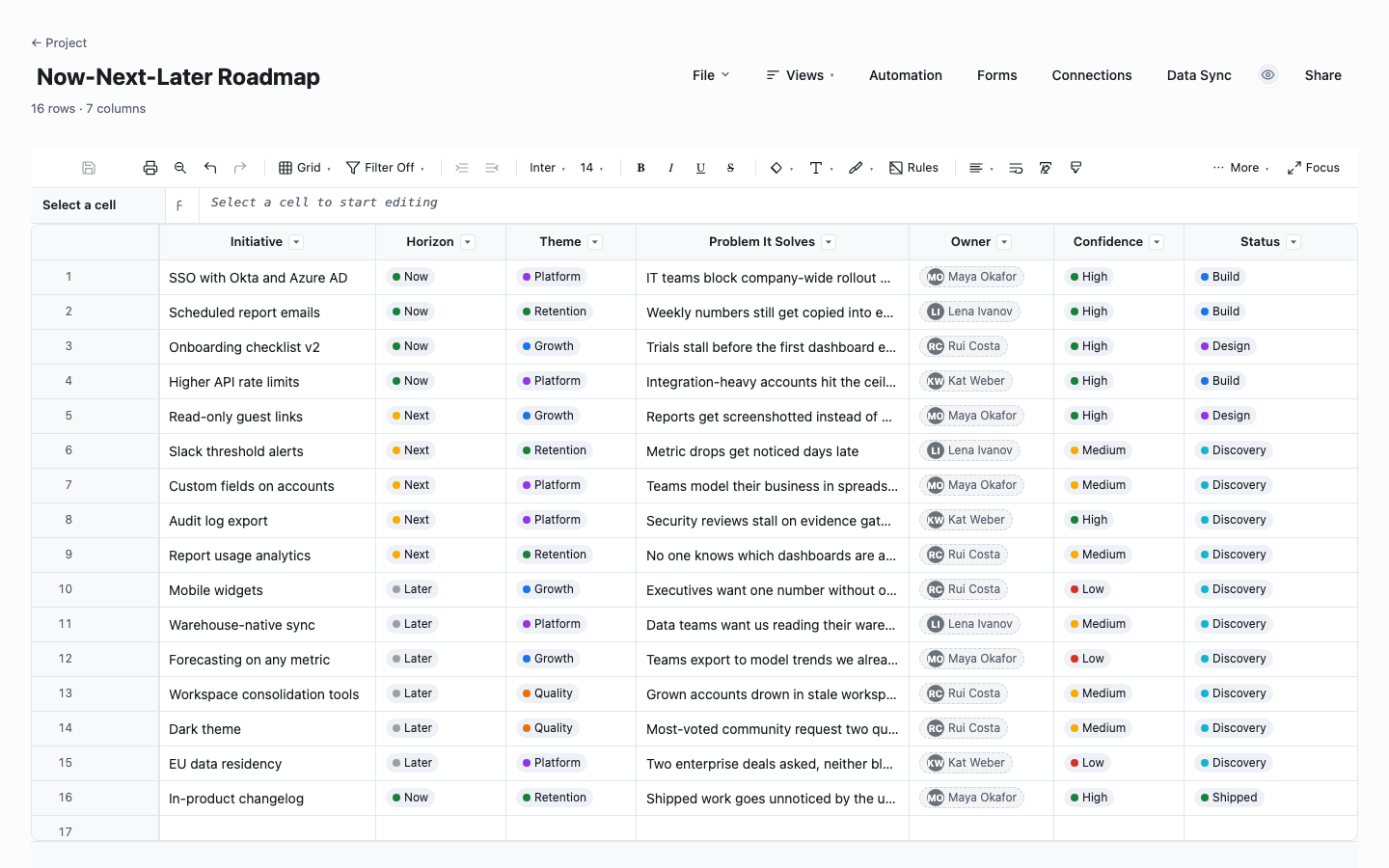
Now-Next-Later Roadmap
The format that tells the truth about uncertainty. Now is being built, Next is committed, Later is direction, and no initiative carries a date it cannot keep. Each row names the problem it solves rather than just the feature, carries an owner and a confidence level, and moves between horizons as evidence arrives. This is the version to share outside the building, because it promises sequence and intent instead of dates you will miss.
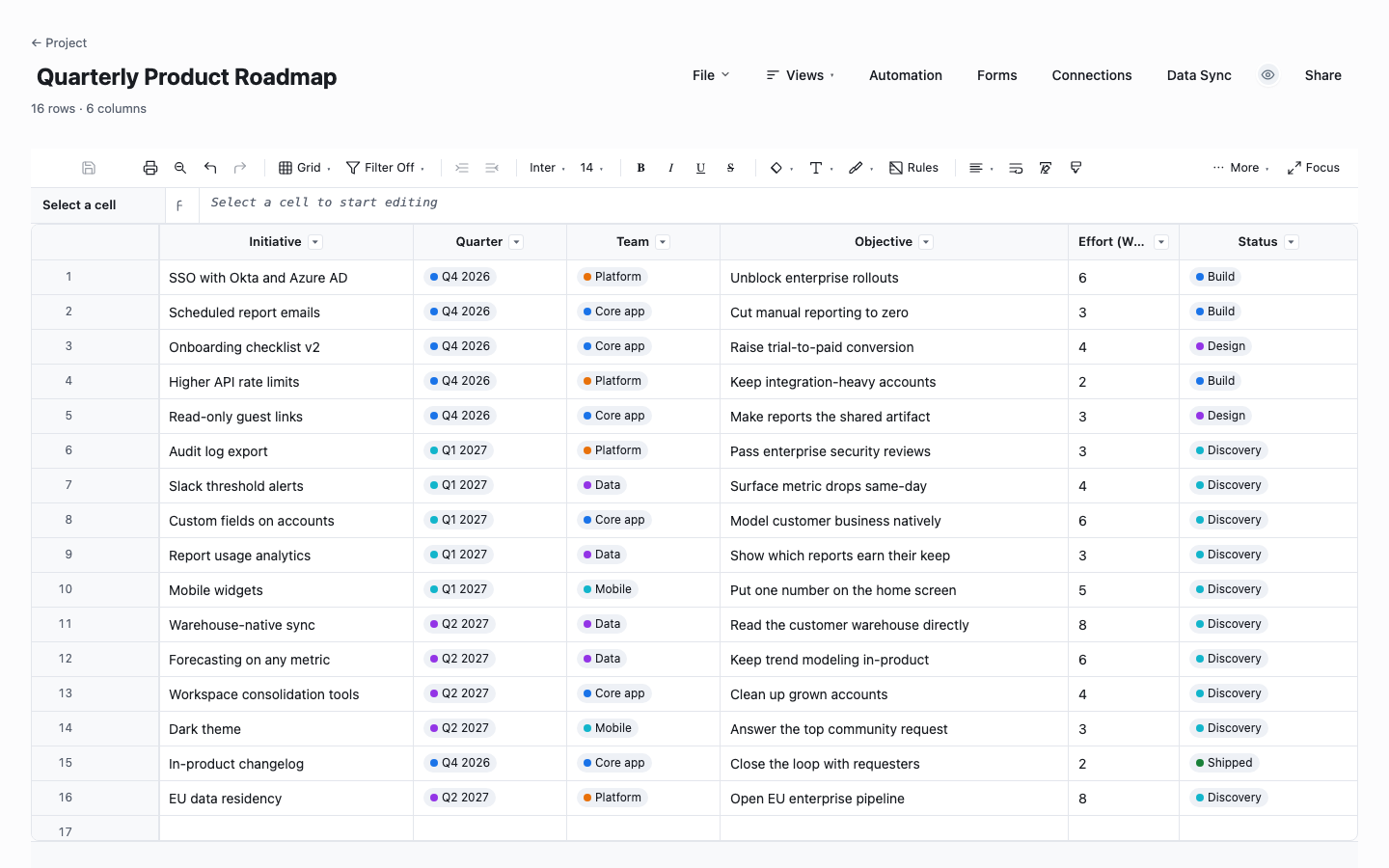
Quarterly Product Roadmap
The planning version, for organizations that budget and review by quarter. Every initiative lands in a quarter with a team, the objective it serves and an effort estimate in weeks, so a quarter that is oversubscribed shows itself before the commitment is made instead of in week ten. Filter by team for standups, group by quarter for the planning meeting, and move slipped rows forward with a two-second dropdown edit rather than a redesign of a slide.
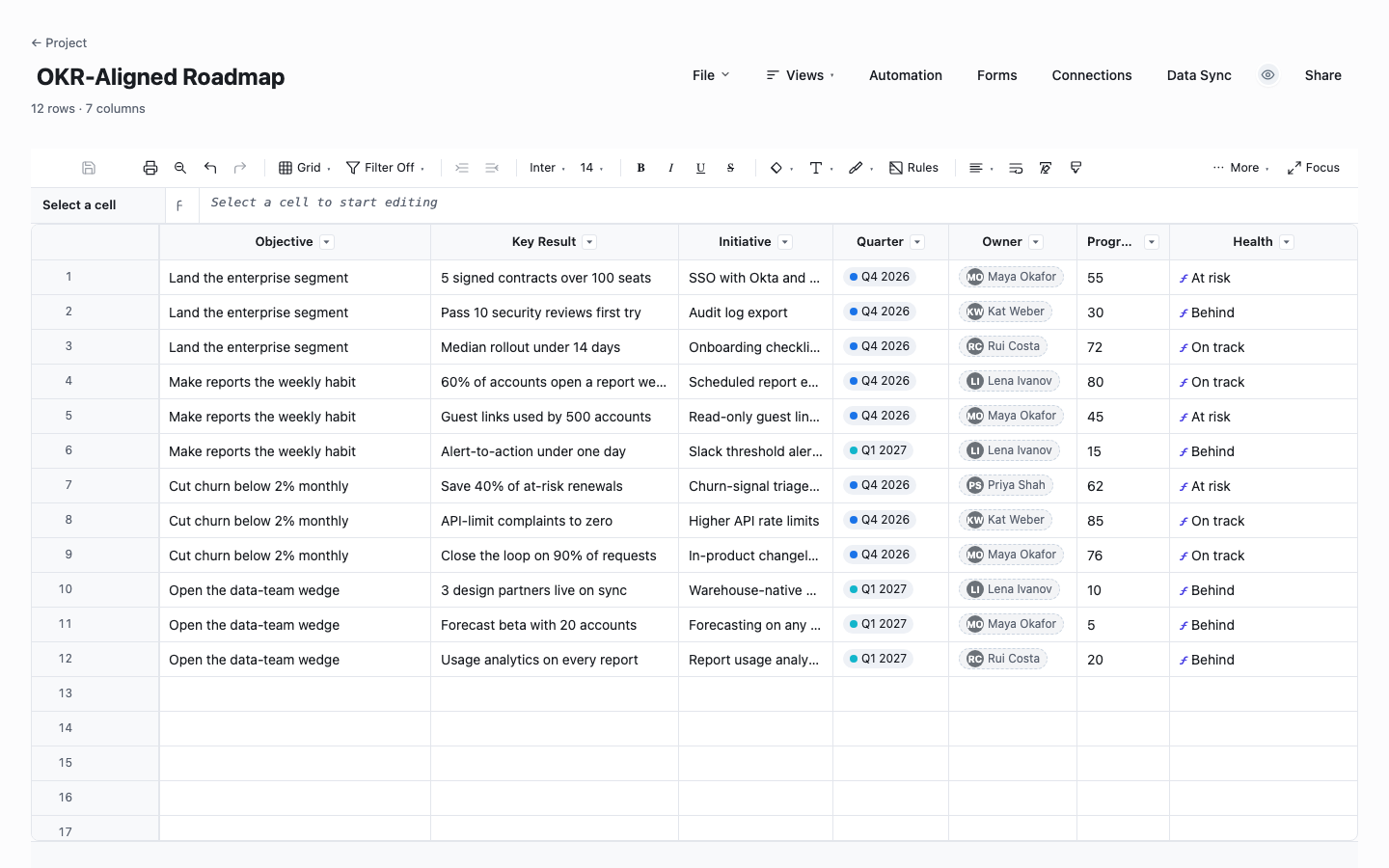
OKR-Aligned Roadmap
The version that answers why before what. Every initiative hangs off an objective and the key result it is supposed to move, with a progress percentage and a Health column the sheet computes: =IF([Progress (%)]@row >= 70, "On track", IF([Progress (%)]@row >= 40, "At risk", "Behind")). When an initiative cannot name its key result, that is the review finding its first cut candidate. Use it when the roadmap meeting keeps drifting into a feature wish list with no scoreboard.
How to keep a product roadmap alive past the first month
Write problems, not just features
An initiative named "SSO with Okta" tells engineering what to build; a row that also says "IT teams block company-wide rollout without it" tells everyone else why it beat their favorite to the top of Now. The problem column is what lets you swap the solution later without the roadmap looking like a broken promise, because the commitment was to the problem all along.
Let confidence do the honesty work
Every roadmap fight is really a fight about certainty, so make certainty a column. High confidence means discovery is done and scope is understood; Low means the row is a bet you are still researching. Executives read a Later row with Low confidence correctly without a meeting, and the PM stops having to choose between sounding sure and being honest.
Cap Now at what the team can actually hold
The now-next-later format fails one way: Now becomes a parking lot with twelve initiatives and three engineers. Keep Now at the work genuinely in flight this cycle, four to six rows for most teams, and force the trade: something enters Now only when something leaves. The discipline is unpleasant exactly once per initiative, which is cheaper than a roadmap nobody believes.
Review the sheet, not a rebuilt deck
The roadmap review should open the living sheet, sorted by horizon or grouped by quarter, and walk the rows that changed. When the review artifact is the working artifact, the meeting spends its time on decisions instead of on reconciling two versions of reality, and the sheet leaves the room already updated because the edits happened live in front of everyone.
Move rows the moment reality moves
A roadmap dies the first week it says something the team knows is false. The maintenance cost of a sheet roadmap is genuinely small, a dropdown edit when an initiative slips from Next to Later, a status flip when discovery starts, and that small cost is the entire difference between a roadmap people check and a roadmap people route around to ask you in chat.
Feed the roadmap from triaged feedback, not memory
The Later column should be downstream of evidence. When your feedback triage sheet shows the same request tagged across nine accounts, that pattern earns a roadmap row with the reach to prove it; when a Later row has no feedback trail at all, that is worth knowing too. Keeping both sheets in one tool means the roadmap review can click straight into the quotes behind a row.
Now-next-later or quarterly: which roadmap format?
Choose by who reads it and what they punish. Now-next-later is for audiences that punish missed dates: customers, the public roadmap page, sales calls. It promises order and intent, and it absorbs a two-week slip without a single edit. Quarter-based is for audiences that punish vagueness: leadership planning headcount and budget against a calendar. It trades resilience for precision and demands more maintenance when things move.
Plenty of teams run both off the same initiative list: the quarterly sheet internally, the now-next-later view outward. That is a filter-and-hide-columns job, not a second roadmap. What does not work is showing the dated version to customers and then treating the dates as estimates; pick the format whose promise you intend to keep.
The status report that builds itself
The quiet tax of roadmap ownership is the reporting loop: every week, some version of "where are we on the roadmap" gets rebuilt by hand for a different audience. The escape is making the roadmap sheet the single source the reporting reads from. In Wisegrid, a dashboard sits on top of the same rows: shipped per quarter, initiatives by status, the at-risk list. The team edits rows; the exec view re-rolls itself. Nobody compiles anything.
The same rows also answer sideways questions without a meeting. Sales wants to know what is coming for their enterprise deal: filter Theme to Platform, share the view. The board wants last quarter: filter Status to Shipped. A roadmap that can be queried is a different tool from a picture of one, and the difference compounds every week you do not rebuild a deck.
When the roadmap outgrows the file
A roadmap spreadsheet fails socially before it fails technically: the file gets attached to an email, three copies diverge, and within a month the roadmap is wherever the PM's local version is. The whole value of a living roadmap is that there is exactly one, and a file cannot enforce that.
In Wisegrid the roadmap is one shared sheet with the whole company reading the same rows. Editors cost $19 a seat; viewers are free, always, which matters for a roadmap precisely because its readers outnumber its writers fifty to one. Confidence and Health render as colored pills, the OKR version's Health column computes live, and the exec dashboard reads the same rows the team edits. Import the .xlsx you just downloaded and the structure comes with you.
Frequently asked questions
What should a product roadmap template include?
Six columns do the work: the initiative, its horizon or quarter, a theme, the problem it solves, an owner and a status. The two most skipped are the problem statement and a confidence level, and they are the two that make a roadmap defensible: one records why the row deserves its place, the other tells readers how settled the plan is without a disclaimer meeting.
What is a now-next-later roadmap?
A roadmap with three horizons instead of dates. Now is in delivery this cycle, Next is committed and queued, Later is direction that has earned interest but not commitment. Its strength is honesty under uncertainty: work moves between horizons as evidence arrives, and a slip costs an edit rather than credibility, which is why it has become the default format for customer-facing roadmaps.
Should a product roadmap have dates on it?
Internally, quarters usually earn their keep because planning and budgeting run on them. Externally, dates on a roadmap are promises, and most teams should promise sequence rather than timing: now-next-later externally, quarters internally, both views off the same initiative list. If a customer contract needs a date, that date belongs in the contract conversation, not on the public roadmap.
How often should a product roadmap be updated?
Edit it the moment reality moves, review it on a rhythm: weekly glance for status, monthly for horizon moves, quarterly for the full re-rank. The sheet format is what makes that cadence cheap, since a slip is a dropdown edit rather than a deck rebuild. A roadmap that is only touched the night before the review is a report about the roadmap, not the roadmap.
How do I tie a roadmap to OKRs without it becoming theater?
Put the objective and key result on each initiative's row and let the mapping be falsifiable. The OKR-aligned version here computes a Health column from the progress number, so the review reads Behind next to a row instead of hearing a narrative. The useful failure is an initiative that cannot name its key result: either the work or the OKRs need editing, and the sheet forces the question early.
Can I use this product roadmap template in Excel?
Yes. All three downloads open in Excel or any app that reads .xlsx, with dropdowns intact and realistic sample rows. The OKR version's Health column arrives as computed values, since formula syntax differs between apps. Rebuilding the IF from the copy above takes a minute, or run the sheet in Wisegrid where the formula computes live as progress numbers change.
Run it live instead of in a file.
The downloads above are yours either way. In Wisegrid the same template becomes a working sheet with owner contacts, status dropdowns, reminders, and dashboards. 7-day free trial, no credit card required.