Roofing Estimate Template: From Squares and Pitch to a Signed Number (2026)
A roofing estimate template earns its keep in the gap between a measurement and a price. The roof is 1,960 square feet of footprint on a 6/12 pitch. What does the homeowner pay? The sheet below walks that math in the open: footprint times pitch factor gives roof area, area becomes squares, waste gets added before anyone prices a bundle. Then every line item from tear-off to ridge vent lands in its own row with a quantity and a unit cost, and the estimate does its own arithmetic from there.
All three versions come pre-filled with the same job, a 21.9-square architectural reroof that totals $17,342, because a template full of zeros teaches nothing. You can see what a believable waste factor looks like, where overhead sits relative to margin and what the customer block should say. Swap in your own measurements and rates, and the totals follow.
Price a roof in the browser. No signup.
A working slice of the estimate you can type into right now. Change a quantity, reword a line, retag a row. Edits live in your tab only and clear when you close it. One click on the signup path turns it into a sheet that keeps.
| Item | Detail | Qty | Unit | Unit cost | Type | Line total |
|---|---|---|---|---|---|---|
Sandbox only, edits don't persist. Want to keep your work? Start your 7-day free trial →
Three roofing estimate templates, free to download
Each file is a working sheet exported from Wisegrid with the full sample job in it, not a blank grid with bold headers. They open in Excel or any .xlsx spreadsheet app. Download whichever fits the job in front of you, no email required.
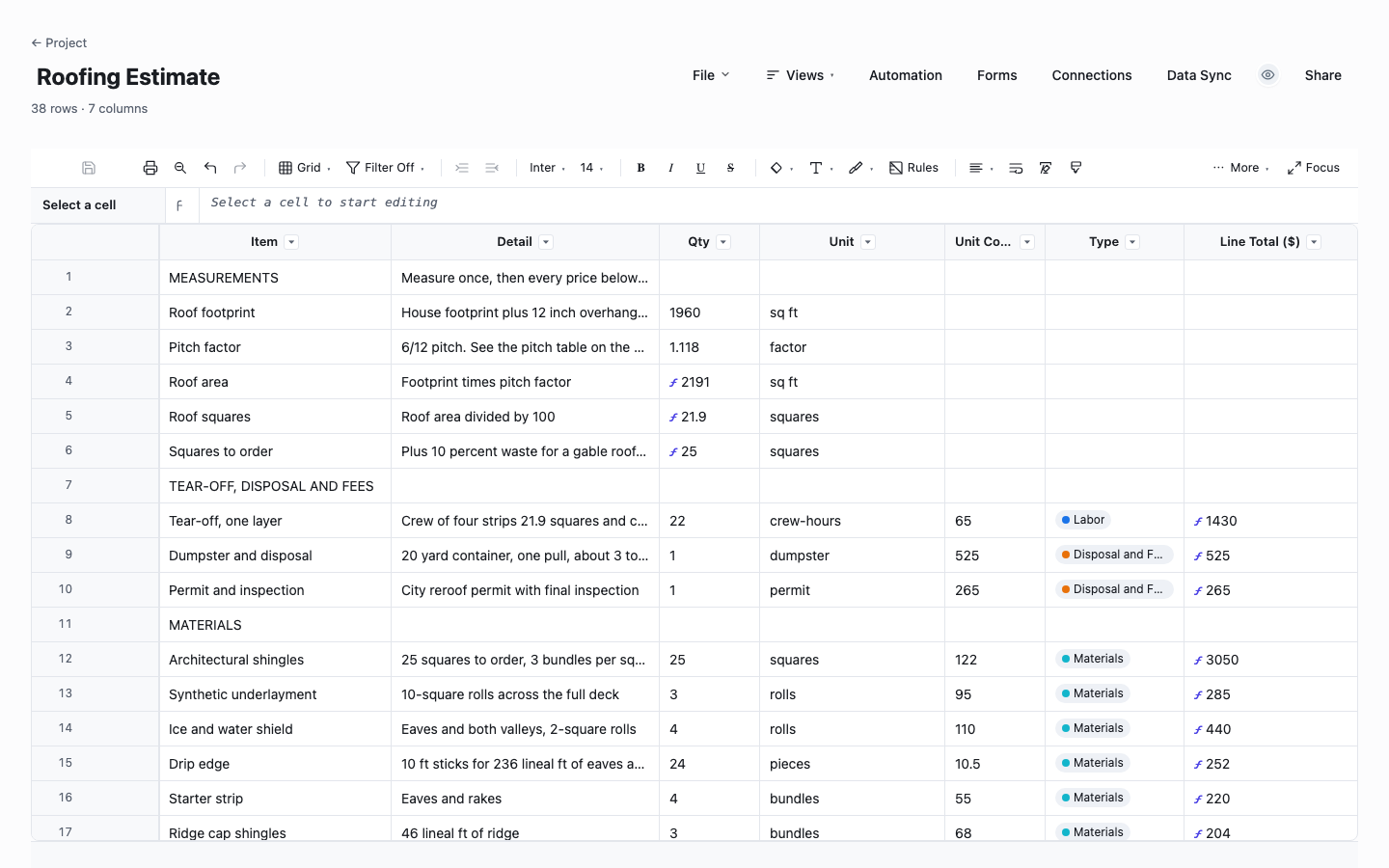
Roofing Estimate
The full estimate, built for a mid-size residential reroof. A measurements block turns footprint and pitch into squares and adds waste before anything gets priced. Below it, seventeen priced rows cover tear-off, disposal, the permit, nine material lines and labor in crew-hours. The summary splits materials from labor, adds 10 percent overhead and a 20 percent margin, then closes with tax and a customer block: price per square, deposit at signing, balance on completion. Every computed cell is a live formula in Wisegrid, so changing one quantity reprices the whole job.
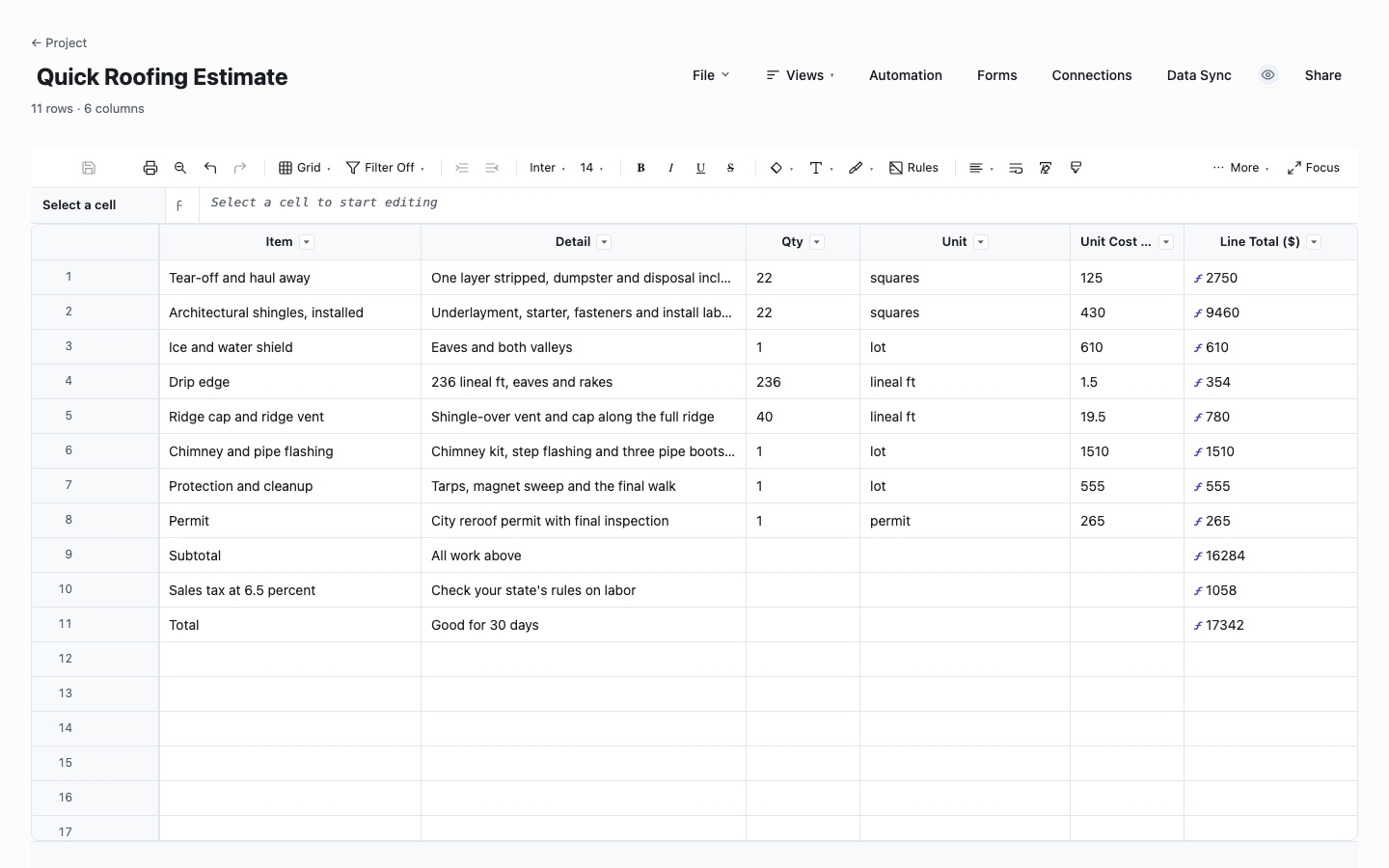
Quick Roofing Estimate
The same 21.9-square reroof as the full estimate, collapsed to one page. Eight lump lines priced per square or per lot, tear-off through permit, with subtotal, tax and total computing at the bottom. Overhead and margin fold into the lump rates instead of standing in their own rows, so it lands on the same $17,342 while trading the itemized breakdown for speed: a number in the homeowner’s hand before you leave the driveway. Move up to the full estimate when the homeowner wants the materials itemized or the margin math laid out row by row.
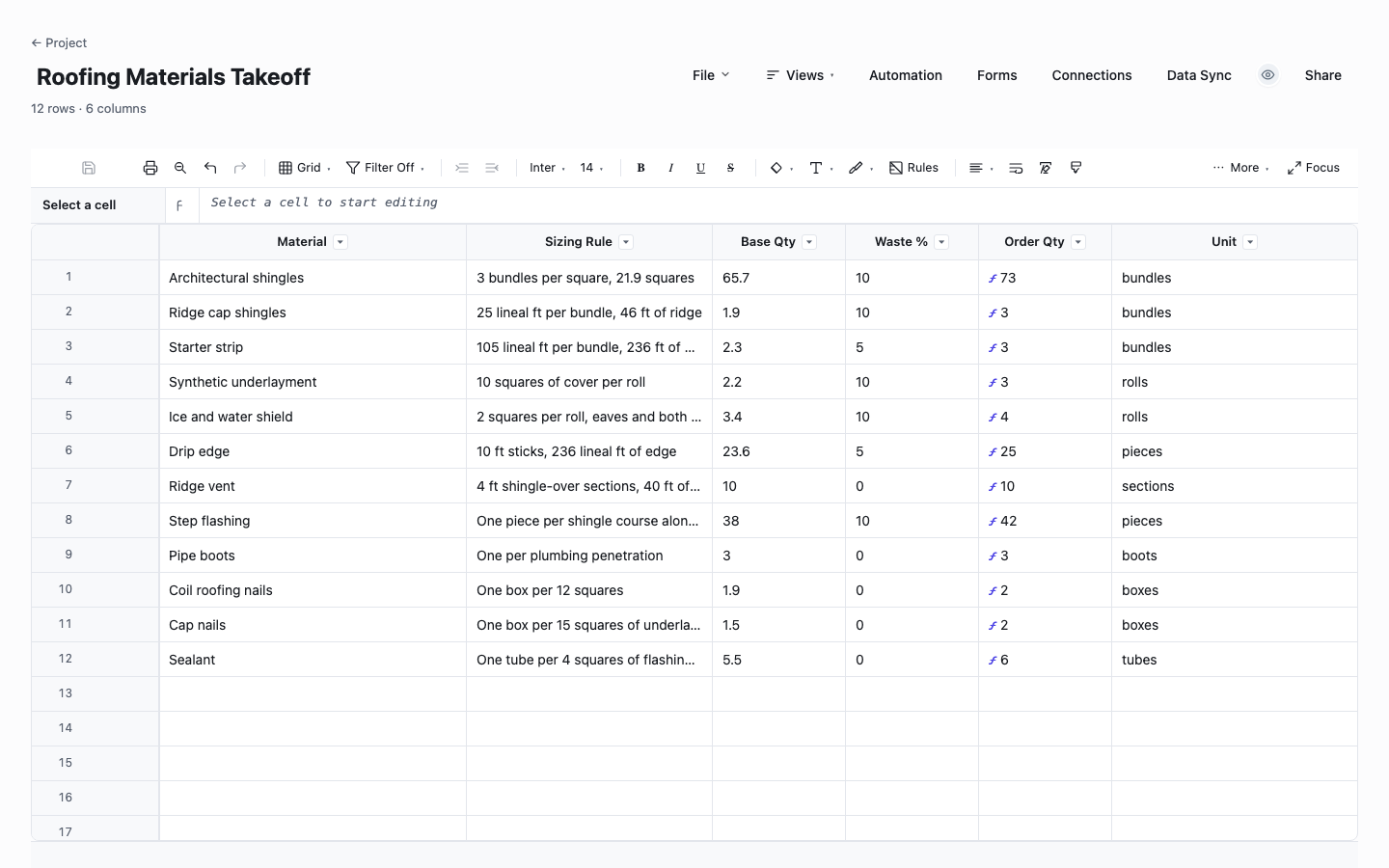
Roofing Materials Takeoff
The order sheet behind the estimate. Twelve materials, each with its sizing rule written into the row: 3 bundles per square, one ice and water roll per 2 squares, one step-flashing piece per shingle course. A waste percentage sits beside the base quantity and the order quantity rounds itself up to whole bundles and rolls with a CEILING formula. Hand it to the supplier as the order list, then reconcile it against invoices when the job closes.
How to build a roofing estimate that survives the job
Measure the footprint, then let the pitch factor do the climbing
Measure the house footprint from the ground or a satellite tool, add the overhangs, then multiply by the pitch factor instead of crawling the whole deck with a tape. A 6/12 roof multiplies by 1.118, a 9/12 by 1.25. The template holds these as plain numbers you can see and challenge, which matters when a homeowner asks where 2,191 square feet came from on a 1,960 foot house.
Convert to squares and add waste before pricing anything
Divide roof area by 100 to get squares, then add waste while the number is still a measurement. Ten percent covers a plain gable. Cut-up roofs with hips, valleys and dormers want 15 percent. The sheet rounds the order up to whole squares because suppliers sell bundles, not fractions, and a crew that runs two bundles short at 3 pm loses the rest of the day.
Price the roof system, not just the shingles
Shingles are one line of nine in the materials block. Underlayment, ice and water shield at the eaves, drip edge, starter, ridge cap, ridge vent, flashing and fasteners each get their own row with a real unit cost. Estimates that lump these into a shingle price go quietly broke on the accessories, which run near $2,400 on this sample job.
Estimate labor in crew-hours at a loaded rate
The sample prices tear-off at one crew-hour per square and install at two, with detail work on flashing broken out at the lead installer’s higher rate. Crew-hours make the labor lines auditable: when a job runs long you can see which line absorbed the overrun. A single "labor" lump sum hides exactly the thing you need to learn for the next bid.
Add overhead first, then margin on the price
Overhead is a cost, so it goes on before profit. The sheet adds 10 percent for insurance, trucks and supervision, then applies a 20 percent margin by dividing by 0.8 rather than multiplying by 1.2. That distinction is worth real money on every job, about $650 on this one, and the margin section below walks through it slowly.
End with the block the customer reads
The last rows translate contractor math into homeowner language: total price, price per square, a 30 percent deposit and the balance due after the final walk. Read it aloud before sending. If a line needs a verbal explanation to survive, its Detail cell needs another sentence, because the estimate will be reread at the kitchen table without you there to defend it.
The measurements block: squares, pitch factors and waste
A square is 100 square feet of roof surface, and the whole trade prices in it. The template computes squares in a chain you can inspect: =ROUND([Qty]2 * [Qty]3, 0) turns footprint and pitch factor into roof area, the next row divides by 100, and =CEILING([Qty]5 * 1.1, 1) adds gable-roof waste and rounds up to whole squares. Wisegrid reads those bracketed column references natively, so the chain recalculates the moment you type a new footprint.
Pitch factors are fixed by geometry. A 4/12 roof multiplies the footprint by 1.054, a 6/12 by 1.118, an 8/12 by 1.202, a 10/12 by 1.302 and a 12/12 by 1.414. Steeper than 8/12 also tends to add a labor premium of 15 to 30 percent, which belongs in the crew-hour lines rather than hidden in a padded material price. Keep the factor visible in its own row and the estimate stays checkable by anyone.
Overhead and margin: the two rows that decide if roofing pays
The sample job carries $11,843 of direct cost. Overhead at 10 percent adds $1,184, and then comes the row most estimates get wrong. A 20 percent margin is not a 20 percent markup. The sheet computes price as cost divided by 0.8, with the formula =ROUND(([Line Total ($)]29 + [Line Total ($)]30) / 0.8 * 0.2, 0) writing the margin into its own visible row, $3,257 here. Multiplying cost by 1.2 instead would have left about $650 on the table, and it does so on every single job. Our markup vs margin calculator below lets you test the difference on your own numbers.
In the Excel downloads these computed cells arrive as values, the numbers for the sample job, because each spreadsheet app speaks its own formula dialect. Rebuilding the chain with your app’s functions takes a few minutes. Opened in Wisegrid, the sheet keeps its formulas live, and the same math powers the job profit and labor cost calculators in our free tools if you want to sanity-check a bid without opening the template.
Estimate or quote: which document the homeowner gets
An estimate is an informed approximation and should say so on the page. A quote is a fixed offer you are expected to hold. Roofing lives mostly in estimate territory because the deck hides its condition until tear-off, so the honest move is an estimate with a written allowance, for example decking replacement at $85 per sheet beyond the first two. Surprises then become line items you both already agreed on instead of change-order fights.
When a commercial client or an insurance job demands a firm number, switch documents. Our quote template is built for that promise, with validity dates and a tracker for what you have outstanding. Price the risk in before you sign it. The two sheets share the same line-item bones, so moving an estimate to a quote is a copy, not a rebuild.
Frequently asked questions
How many squares is a typical residential roof?
Between 17 and 25 squares covers most single-family homes, where a square is 100 square feet of roof surface. The sample job in this template is 21.9 squares: a 1,960 square foot footprint on a 6/12 pitch. Footprint alone understates every roof, so always multiply by the pitch factor before converting to squares.
What waste factor should a roofing estimate use?
10 percent for a straightforward gable roof, 15 percent once hips, valleys or dormers start generating cut shingles, and up to 20 percent on complex cut-up roofs. Waste applies to shingles and underlayment, while starter and ridge cap are figured off lineal feet of edge and ridge instead. The takeoff download carries a waste column per material so each one gets its own number.
What pitch multiplier do I use for each slope?
The common table: 4/12 is 1.054, 5/12 is 1.083, 6/12 is 1.118, 7/12 is 1.158, 8/12 is 1.202, 10/12 is 1.302 and 12/12 is 1.414. Multiply the ground-level footprint, overhangs included, by the factor for the slope. Above 8/12 most crews also add a steep charge to labor, entered in the crew-hour rows rather than buried in material prices.
How much does a roofing estimate come to per square in 2026?
Architectural shingle reroofs commonly land between $450 and $850 per square installed, tear-off included, depending on region, pitch and access. The pre-filled job in this template totals $17,342 on 21.9 squares, which is $792 per square. If your estimate falls far outside that band, check the labor rate and the margin row before trusting it.
How many crew-hours does a tear-off and reshingle take?
Plan about one crew-hour per square to strip a single layer and two crew-hours per square to install architectural shingles, so a 22-square roof runs near 66 crew-hours before detail work. A crew of four clears that in two working days with decent weather. Second tear-off layers, steep pitches and bad access each add hours, and they belong on their own labor lines.
How much overhead and margin belongs in a roofing estimate?
A common working shape is 10 percent overhead on direct costs and a 20 to 30 percent margin computed on the price. On the sample job that is $1,184 of overhead and $3,257 of margin over $11,843 of direct cost. Margin divides by 0.8, markup multiplies by 1.2, and confusing the two shorts you about 4 percent of every invoice.
What does shingle disposal cost on a reroof?
A 20 yard dumpster runs $400 to $600 in most markets and holds roughly 3 tons, which covers a single-layer tear-off around 22 squares, since asphalt shingles weigh 250 to 300 pounds per square. Two layers or oversize roofs need a second pull. Price disposal as its own line so a surprise second layer becomes a visible change instead of eaten margin.
What is the difference between a roofing estimate and a quote?
An estimate is an informed approximation, a quote is a fixed price you are expected to honor. Roofs hide their condition until tear-off, so most residential work goes out as an estimate with written allowances for decking and flashing surprises. Our quote template linked below handles the fixed-price case, with validity dates and a pipeline tracker for outstanding offers.
Run it live instead of in a file.
The downloads above are yours either way. In Wisegrid the same template becomes a working sheet with owner contacts, status dropdowns, reminders, and dashboards. 7-day free trial, no credit card required.