Business Case Template: Free Downloads and a Write-It-Well Guide for 2026
A business case is the argument that turns an idea into an approved decision: the problem, the options, the recommendation, and the benefits, costs, and risks that justify it. Every funded project traces back to one, whether it was written on a page or shouted across a requisition form. A good business case template does two jobs at once: it gives the writer a structure that hits what approvers look for, and it gives the approver a document where every claim has an owner and every number can be challenged in a single read.
The versions on this page cover the four shapes a decision actually takes. The standard case walks through problem, options, recommendation, benefits, costs, and risks. The lean case answers five questions for decisions that cannot wait for a committee. The financial case lines up year-by-year projections so payback timing is visible. The one-page case compresses everything into eight rows for a modest ask. Each is pre-filled with a fictional regional bank weighing a branch renovation or a manufacturer weighing a second press, so the structure is visible before you replace a single cell.
Four business case templates, free to download
Each version below is a working spreadsheet, not a blank grid with a title row. The fields are pre-filled with realistic example content from a fictional regional bank and a precision manufacturer so you can see how a finished business case reads, then overwrite it with your own details. What you download is an everyday spreadsheet file, compatible with all the usual tools. No email address required.
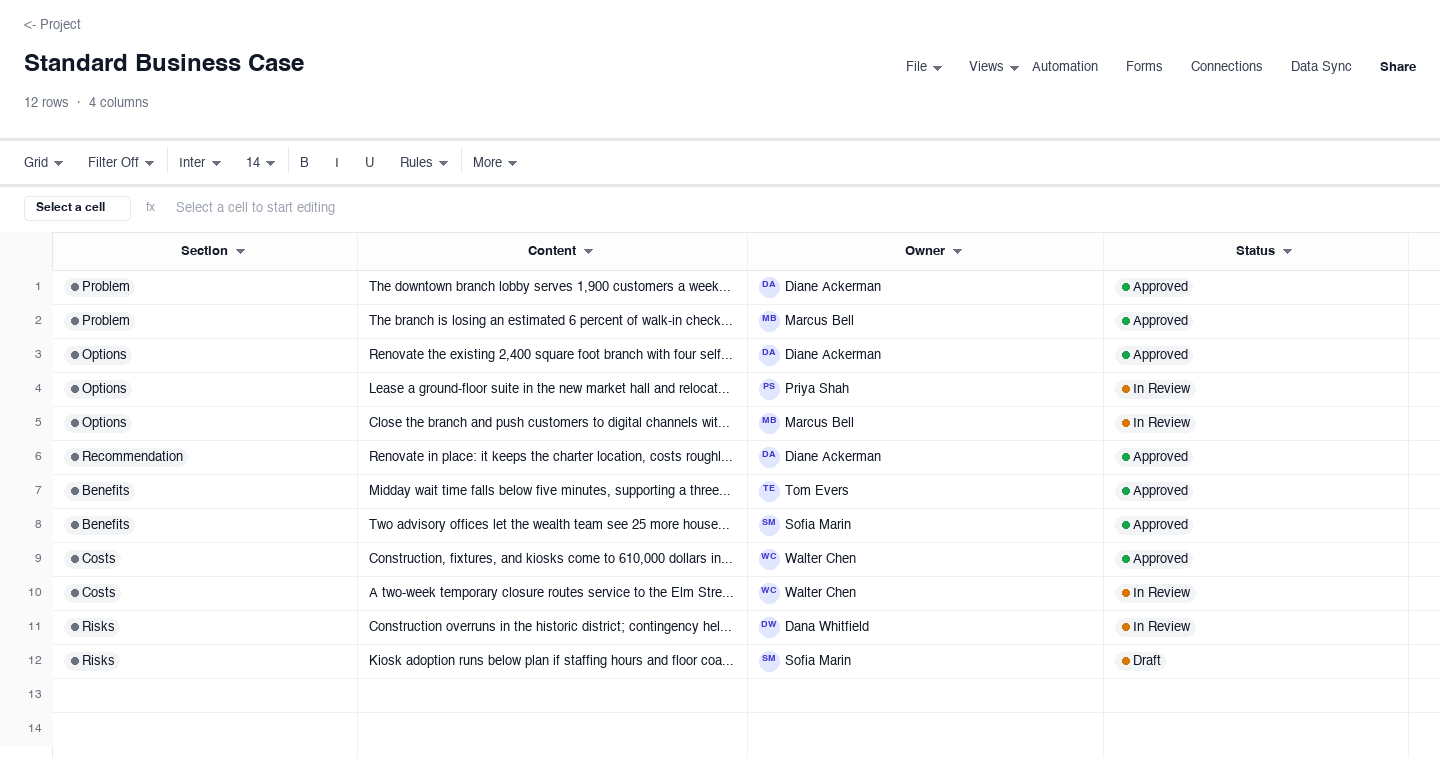
Standard Business Case
The standard business case walks a decision through the sections executives expect: the problem, the options considered, the recommendation, the benefits, the costs, and the risks, each with an owner and a status. Use it for capital requests and policy changes that need formal review, because it gives the approver one document where every claim has a named owner and nothing important lives only in a meeting recording. The status column keeps the drafting effort honest about what is settled and what is not.
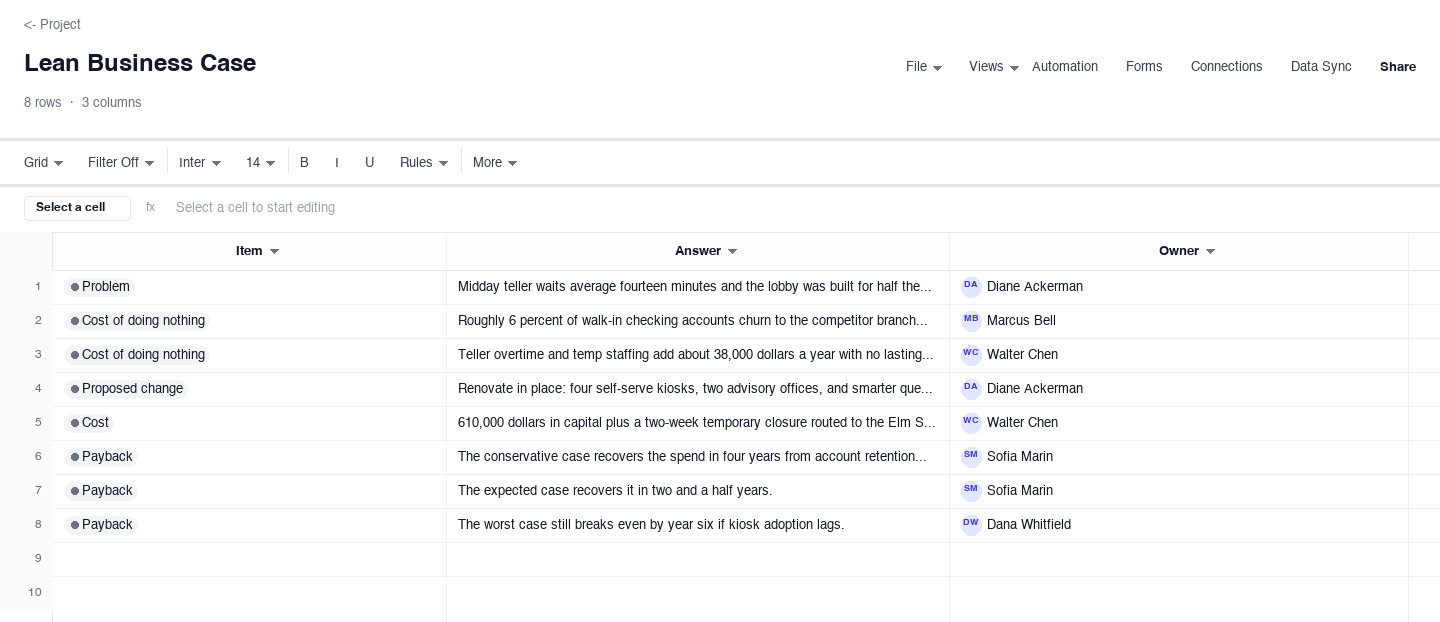
Lean Business Case
The lean business case fits on one sheet and answers five questions in plain language: what is the problem, what does doing nothing cost, what are we proposing, what will it cost, and when does it pay back. Use it for decisions that need a yes or no this month, not a steering committee. The cost-of-doing-nothing row does the heavy lifting, because it reframes the spend against the loss you are already absorbing every quarter you wait.
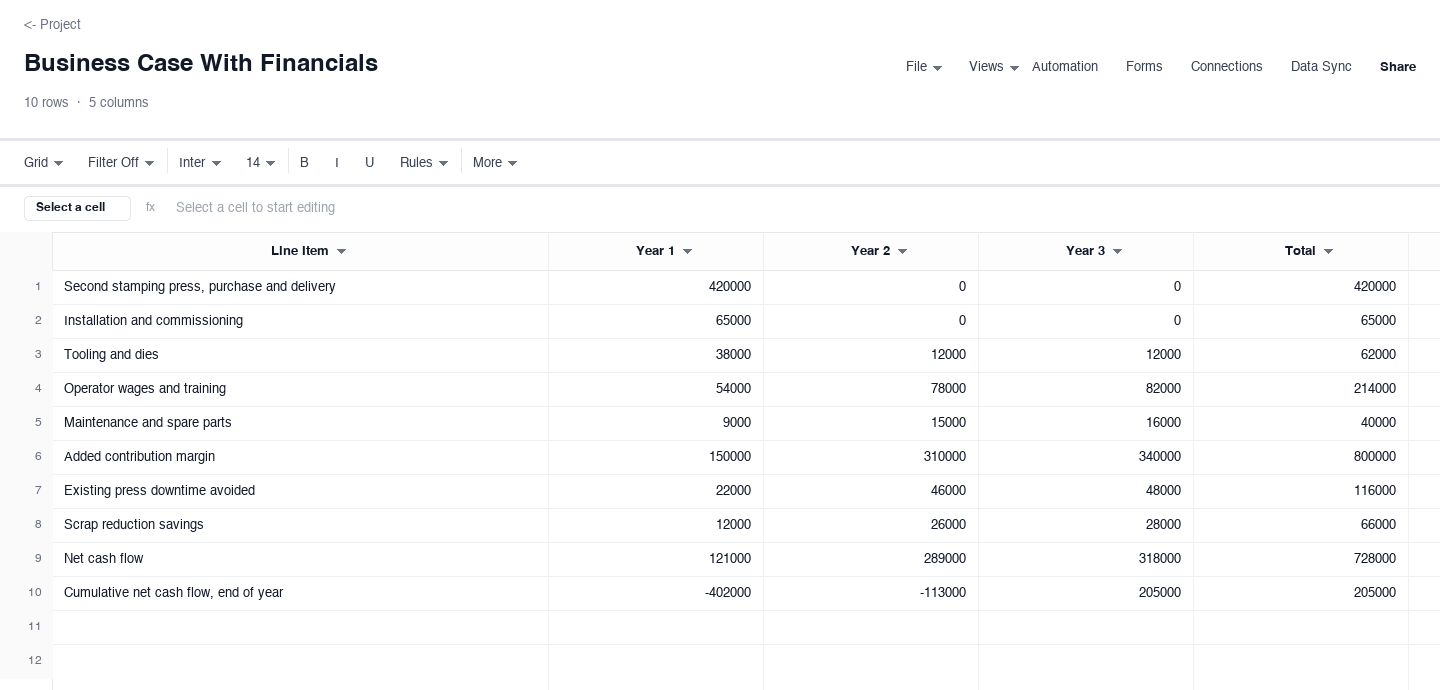
Business Case With Financials
The financial business case puts the numbers beside the narrative: every line item with year one, two, and three figures plus a computed total, so inflows and outflows sit in the same columns. Use it when the decision turns on cash timing, not just on whether benefits exceed costs. The net cash flow and cumulative rows expose the payback month directly, which is the number a finance reviewer asks for first.
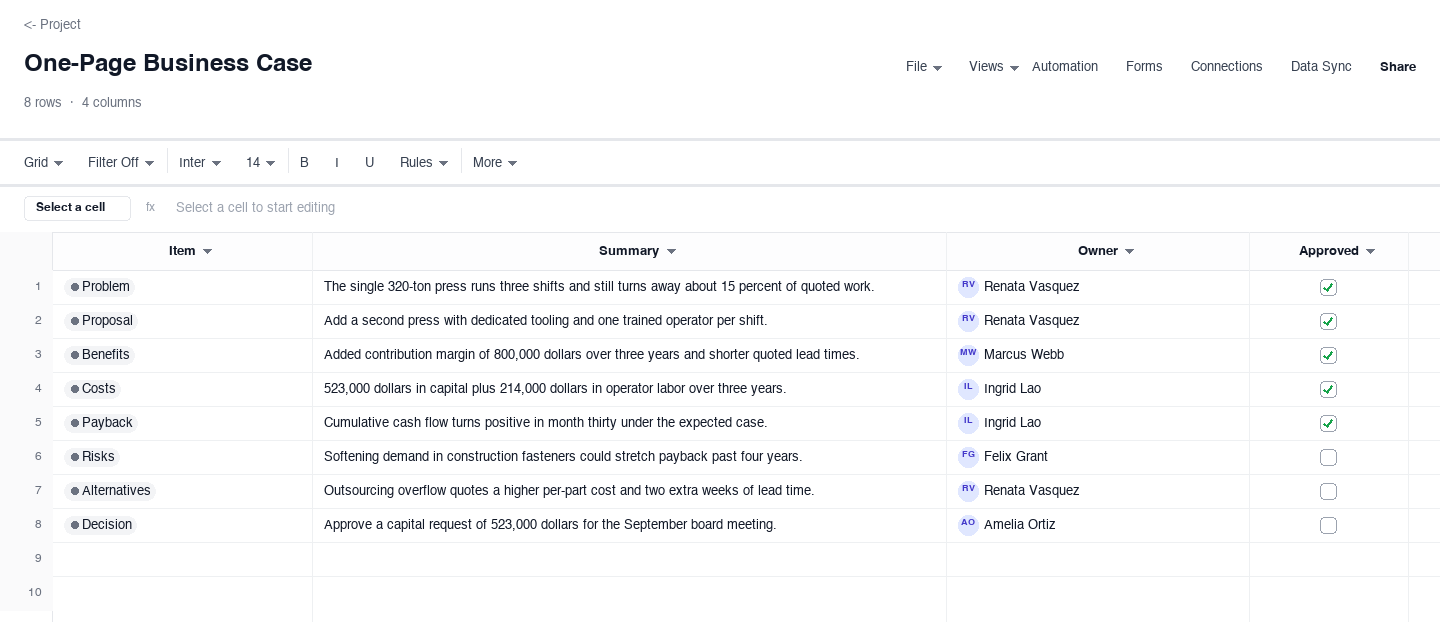
One-Page Business Case
The one-page business case compresses the argument into eight rows: problem, proposal, benefits, costs, payback, risks, alternatives, and the decision being requested, each with a one-sentence summary, an owner, and an approval flag. Use it as the cover sheet for a larger case, or alone when the ask is modest. The discipline is in the summary column: if a row needs two sentences, the case is not ready to circulate.
How to write a business case that gets approved
Start with the problem and the cost of doing nothing
The opening of every persuasive case is the problem stated in operational terms, plus the number that makes it expensive: customers waiting fourteen minutes, a press turning away 15 percent of quoted work, a compliance gap that costs a fine every quarter. Approvers fund problems, not ideas, and the cost of doing nothing is what converts a complaint into a budget line. Write that number conservatively and note where it came from, because it is the figure most likely to be challenged in the room and the one the whole case leans on.
Generate at least three options, including doing nothing
A case with one recommendation reads as a sales pitch; a case with three honest options reads as analysis. Always include do nothing with its real trajectory, plus the cheapest credible alternative, before arguing for the recommended path. Score the options on the same few criteria, cost, benefit, risk, and time to value, so the comparison is visible rather than asserted. Frequently the comparison itself improves the recommendation, because pricing the alternatives forces assumptions into the open where they can be tested before someone else tests them for you.
Quantify benefits and costs in the same units and horizon
Benefits and costs must share a currency and a time window, otherwise the case compares apples to invoices. Put both in dollars over the same three years, and separate one-time capital from recurring operating cost, because approvers weigh them differently. Every figure gets an owner who can defend its source under questioning. A benefit nobody will stand behind, like morale converted to dollars with a shrug, weakens the real benefits beside it, so either find a defensible proxy or drop the line entirely.
Stress-test the recommendation against its risks
Every case carries risks, and naming them first is what gives the recommendation credibility. List the two or three that could actually kill the payback, assign each a likelihood and an owner, and write the mitigation or the tripwire that triggers a review. A risk with an early-warning metric, such as if kiosk adoption stays under 40 percent after two quarters we re-scope, converts the scariest paragraph into evidence that the plan has been thought through rather than wished through.
Name an owner for every section and every number
A business case without owners is a rumor with formatting. Each section, each benefit, each cost, and each risk gets a person whose name sits beside it, because approvers approve people as much as plans. When finance challenges the payback math, someone has to answer without a follow-up meeting. Shared ownership is the subtle killer here: if two names sit on a number, assume neither will defend it, and put one name on it before the case circulates.
Close with the decision requested and a revisit date
The last line of the case should state exactly what is being asked: approve 523,000 dollars of capital at the September board meeting, not we recommend proceeding. Vague endings get deferred, because nobody can sign a fog. Attach the conditions that trigger a relook, a volume threshold, a date, or a regulatory event, so the case stays a living document instead of a fossil. The best cases end a conversation with a decision rather than opening another study.
Business case templates for every kind of decision
The phrase business case templates covers everything from a one-page lean canvas to a financial model with three-year projections, and the right one depends on the size of the ask. The versions above cover the common shapes: the full sectioned case for formal review, the lean five-question case for fast decisions, the financial case for capital requests, and the one-page case for modest spend. All four share one spine: problem, options, recommendation, benefits, costs, risks, and the cost of doing nothing.
Whichever version you download, keep the discipline behind it: every number carries an owner, every option is compared honestly, and the document ends with a specific decision being requested. A template cannot supply those habits, but it can make them the path of least resistance. Start from the version closest to your decision, delete the sections your approvers never read, and let the sheet hold the structure while you bring the argument.
Frequently asked questions
What is a business case?
A business case is the document that argues for a specific decision or investment: the problem, the options considered, the recommendation, and the benefits, costs, and risks behind it. Its job is not to describe a project but to justify spending money or changing direction, which is why the strongest cases lead with the cost of doing nothing. A decision maker should be able to read it once, understand exactly what is being asked, and see who owns each claim.
How is a business case different from a project charter?
A business case comes first and asks whether we should do this at all; a project charter comes after approval and defines how the work will run. The case is written for decision makers and argues with numbers and options, while the charter is written for the team and fixes scope, roles, and authority. If your case reads like a project plan, or your charter reads like an argument, one of the two documents is doing work meant for the other.
What makes a business case persuasive to executives?
Three things: a quantified cost of doing nothing, options that were honestly considered including the cheapest one, and claims tied to named owners. Executives are persuaded by cases that show the decision was not foregone, so a real comparison of alternatives matters more than eloquence about the preferred one. Every number should trace to an owner who will defend it in the room, because an unattributed figure is a claim nobody has to stand behind when the questioning starts.
How detailed should the financials in a business case be?
Detailed enough to show timing, not so detailed that the model becomes the message. For most decisions, annual figures across three years with a net cash flow row and a cumulative row is the right grain: it exposes the payback period, which is the number approvers ask for first. Build the simple version first and add granularity only where a specific question demands it. A case that hides a weak payback inside a beautiful sixty-line model is still a weak case.
Who should approve a business case?
Whoever owns the budget being committed, and whoever absorbs the loss if the benefits do not arrive. In practice that usually means the sponsor manager plus finance for anything above a departmental threshold, with the risk owner consulted in writing. One approver should be named, not a committee, because shared approval is shared blame. After approval, file the case where the project team can find it, since the charter, the budget, and the benefits review all trace back to it.
How long should a business case be?
As long as the size of the ask requires. A five-figure process change deserves the one-page version: problem, proposal, benefits, costs, payback, risks, and the decision requested. A seven-figure capital program deserves the full version with options and three-year financials, but the argument should still survive a one-page summary. The test is whether each section changes a decision; if a paragraph exists only to be thorough, cut it and let the owner answer questions in the room instead.
Run it live instead of in a file.
The downloads above are yours either way. In Wisegrid the same template becomes a working sheet with owner contacts, status dropdowns, reminders, and dashboards. 7-day free trial, no credit card required.