Scope of Work Template: The Best Way to Define the Work in 2026
A scope of work is the section of an agreement that defines exactly what will be delivered, by whom, by when, and how everyone will know it is done. A scope of work template gives that document a standing structure: deliverables, the tasks behind them, milestones, exclusions, client responsibilities, and acceptance criteria, so nothing important gets left to memory or goodwill.
Most project disputes are scope disputes wearing other costumes. The missed deadline traces back to a deliverable nobody defined, the surprise invoice traces back to work one side assumed was included and the other assumed was extra. An afternoon spent writing a real SOW is the cheapest dispute resolution you will ever buy, because it happens while everyone still agrees.
Free scope of work templates to download
Each version below is a working spreadsheet pre-filled with a realistic example project, so you can see how a complete scope of work reads before you adapt it. The files are plain spreadsheets your existing software opens without fuss. No email address required.
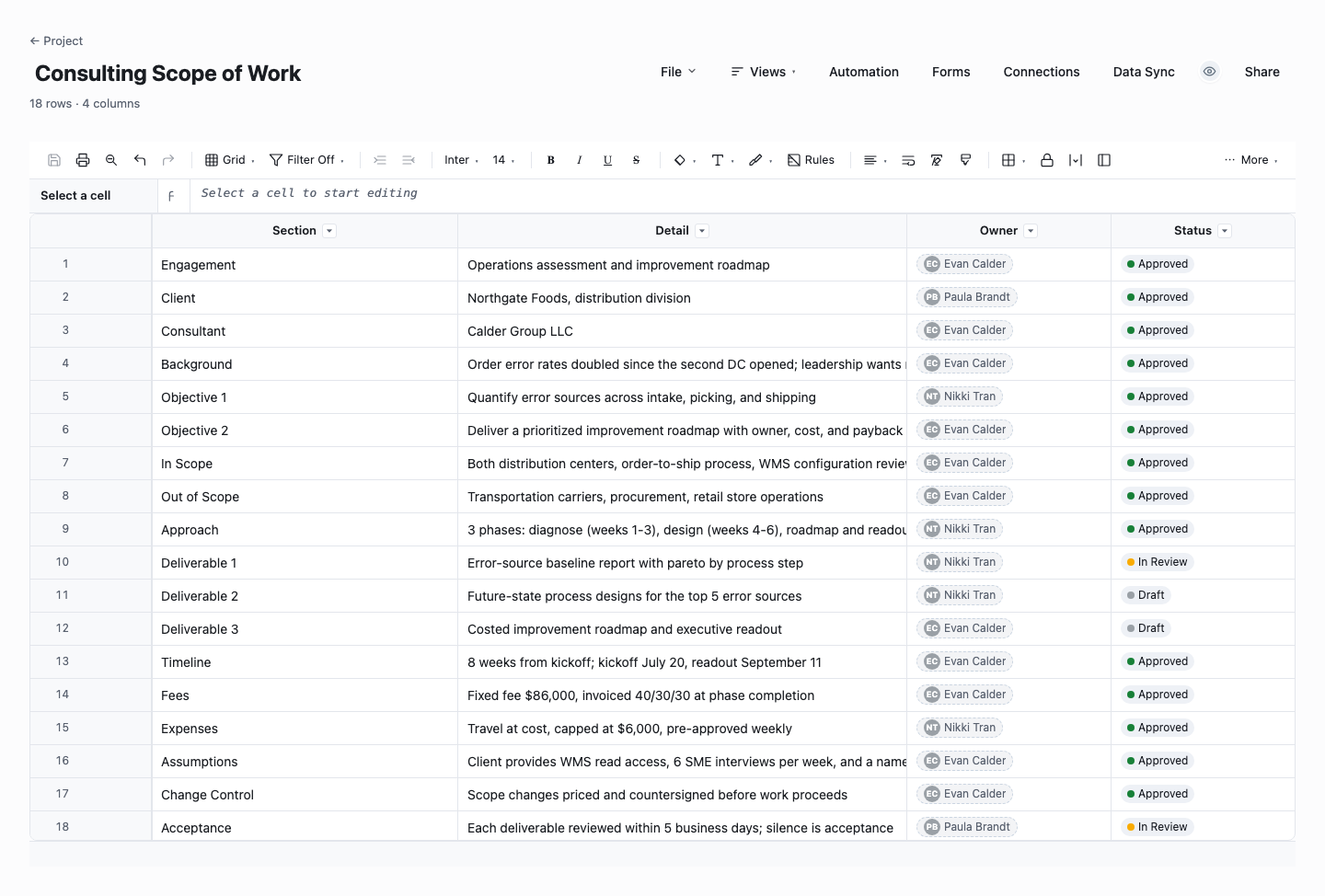
Consulting Scope of Work
The consulting SOW is the full document for professional services: background, objectives, scope, deliverables, timeline, fees, and acceptance criteria, each section carried as a row with an owner and a status. Use it for consulting and agency engagements where the SOW is the working agreement the project runs on. The per-section status column earns its keep during negotiation, because it shows exactly which sections are agreed and which are still moving, which is precisely what you want visible before anyone starts billing hours.
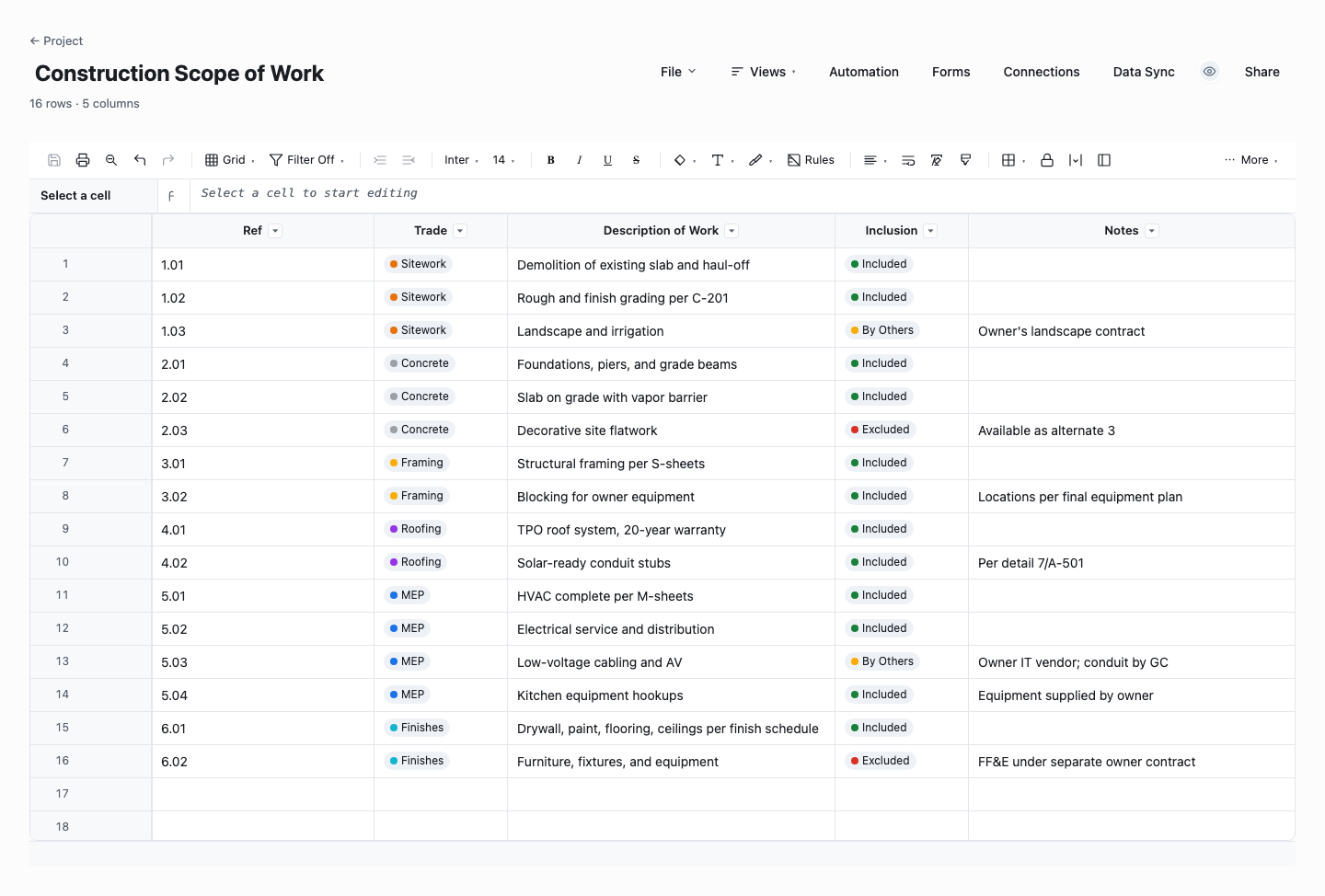
Construction Scope of Work
The construction SOW scopes the job by trade, and its Inclusion column is the entire point: every line of work is explicitly marked Included, Excluded, or By Others. Use it for construction contracts of any size, because the expensive disputes on a job site are rarely about the work that was written down. They are about the work each side assumed the other had. A scope where the exclusions are as explicit as the inclusions is the cheapest litigation insurance available.
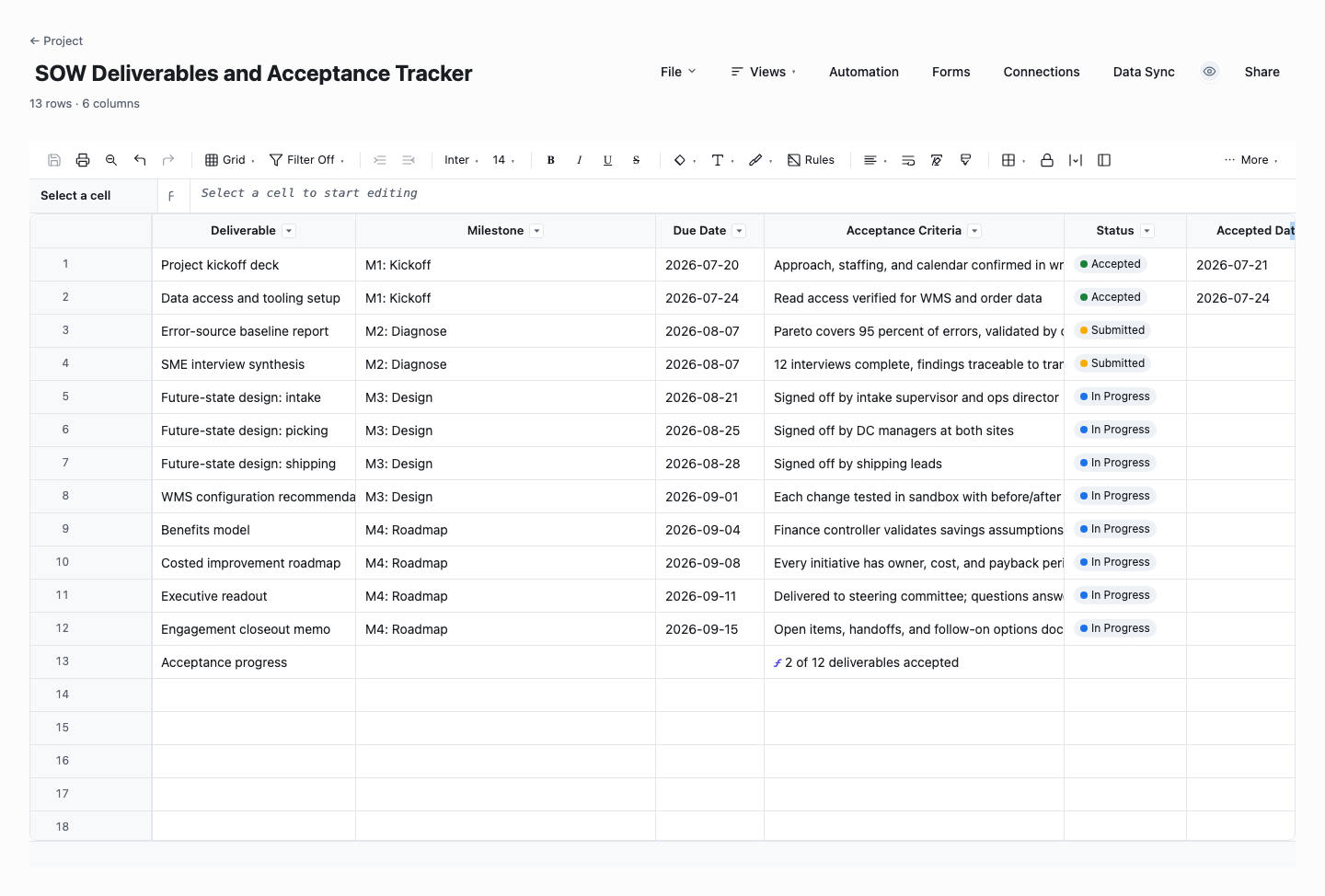
SOW Deliverables and Acceptance Tracker
The deliverables tracker is the delivery half of the SOW: every deliverable with its milestone, due date, acceptance criteria, and sign-off state, plus a live count of accepted deliverables. Use it once the SOW is signed and the work is running, because acceptance is where services revenue actually becomes real, and a tracker that shows exactly what has been formally accepted, what is delivered but unsigned, and what is still due keeps the final invoice from becoming a negotiation.
How to write a scope of work that prevents disputes
Define deliverables before tasks
Start with the things the client will actually receive: the installed system, the report, the trained team, the working website. Each deliverable gets its own row with a description concrete enough to be checked off. Tasks come second, as the work that produces each deliverable, because a SOW organized around activities invites the worst client question there is: we paid for all this effort, but what did we get? As a sanity check, most projects resolve to somewhere between five and fifteen deliverables. Many more than that and you are listing tasks, many fewer and the descriptions are hiding multitudes.
Write acceptance criteria while nobody is angry
For every deliverable, write down how both sides will know it is done: the test it passes, the standard it meets, the person who signs, and how many review cycles are included. "Client approval" alone is not a criterion, it is a veto with no deadline. Add a review window, such as five business days after submission with silence counting as acceptance, and the project gains an ending instead of a fade-out.
Make the exclusions list do the heavy lifting
The exclusions section is where you name the adjacent work you are not doing: the data migration, the content writing, the legacy system, the second location. Every item you list is a future awkward conversation you have already had, in writing, while it was still cheap. Write exclusions by walking the project’s edges and asking what a reasonable client might assume comes with it, because assumptions are exactly what this section exists to catch.
Put dates on milestones, and conditions on the dates
A SOW without dates is a wish list; a SOW with bare dates is a trap. Give each milestone a date and state what the date depends on: client materials received by a stated day, access granted, decisions made within the review window. When a dependency slips, the schedule consequence is then already agreed rather than argued. This single habit removes most of the heat from schedule conversations.
Name the client’s responsibilities explicitly
Projects rarely stall on the vendor’s work alone. They stall waiting for content, approvals, access, and answers. List what the client must provide and by when, with a named owner on their side for each item. This section reads as bureaucratic right up until the first delay, at which point it becomes the fairest sentence in the document, protecting the relationship by making the dependency visible before it bites.
Tie payment to the scope, not the calendar
Where the commercial terms allow it, link payments to accepted milestones rather than dates alone, and reference the SOW’s own deliverable numbers in the payment schedule. This keeps money conversations factual: the invoice cites the milestone, the milestone cites its acceptance criteria, and everyone is reading from the same rows. It also gives the client a clean reason to engage with acceptance promptly.
Version the scope and route changes through a process
The SOW you sign is version one, and real projects generate legitimate changes. Keep the document under version control, date every revision, and route additions through a change order so each one arrives priced and approved rather than absorbed. In Wisegrid the same scope sheet becomes a live document: status dropdowns per deliverable, owner contacts, milestone reminders, and a change log the whole team can see, so the scope everyone references is always the current one.
Project scope statement vs scope of work
The two terms get used interchangeably, but they do different jobs. A project scope statement is an internal planning artifact: it defines what the project includes and excludes for the team and sponsor, and it lives alongside the project charter as part of how the organization governs its own work. A scope of work is usually a two-party document, most often attached to a contract or statement of work between a client and a provider, and it carries commercial weight.
The practical difference shows in the writing. A scope statement can say "improve checkout conversion" and let the team refine it, because everyone reading it shares context and incentives. A scope of work needs the precision of a document that will be read adversarially one day: named deliverables, measurable acceptance criteria, dated milestones, and explicit exclusions. If a sentence would not survive a disagreement about money, it is not finished.
You often need both. The internal scope statement keeps the team aligned on intent, while the SOW binds the commercial relationship to specifics. Write the statement first, then harden the parts that cross the company boundary into the SOW, and keep the two consistent whenever a change order lands.
The template above is built for the outward-facing version, because that is where the money is, but it adapts to an internal scope statement by relaxing the acceptance criteria to team-level definitions of done. If you keep both, give them the same deliverable numbering. A shared scheme is what lets a change conversation move between the internal and contractual documents without anything getting lost in translation.
Frequently asked questions
What should a scope of work include?
Eight sections cover nearly every case: a short project overview, the deliverables with concrete descriptions, the tasks or phases that produce them, milestones with dates, acceptance criteria per deliverable, exclusions, client responsibilities, and the assumptions the plan rests on. Add a change process pointer so additions have a route that is not "absorb it quietly." The template above carries each of these as a section with owners and status, so gaps are visible before signing.
What is the difference between a scope of work and a statement of work?
A statement of work (SOW) is typically the fuller contractual document: scope plus commercial terms such as pricing, payment schedule, warranties, and legal provisions. The scope of work is the heart of it, the part that defines the actual work, and in practice many teams use the two names for the same document. What matters is coverage, not naming: somewhere in the signed papers, deliverables, dates, acceptance criteria, and exclusions must exist in checkable form, and the commercial terms must reference them. If your master agreement and SOW ever conflict, the contract usually states which wins, so read that clause before assuming the newer document controls.
What is the difference between a scope of work and a project charter?
Direction. A project charter is an internal authorization document: it names the objective, sponsor, budget, and boundaries that let a project exist inside an organization. A scope of work faces outward, defining the specific work one party will deliver to another, usually with commercial consequences. On client projects the two coexist and should agree: the charter authorizes your team to do the project, and the SOW defines what the client is buying. When they drift apart, the SOW wins the argument, so keep the charter updated.
Why do exclusions matter so much in a scope of work?
Because scope disputes are almost never about what the document says. They are about what one side assumed it implied. Exclusions are the only section that addresses assumptions directly, by naming the adjacent work that is not included: the migrations, the training, the maintenance, the second phase. Each written exclusion costs one line and one moment of mild awkwardness at signing, and saves a miserable conversation later, held under deadline pressure with money attached.
What are acceptance criteria in a scope of work?
The agreed test for each deliverable: the measurable condition, standard, or review that marks it complete, plus who confirms it and within what window. Good criteria are checkable by a third party: the system processes the stated volume, the report covers the stated topics, the training reaches the stated group. Vague criteria like "to client satisfaction" leave the project without an ending. Include the number of revision rounds too, because "one more small change" is how fixed-price work becomes unpaid retainer work.
Who writes the scope of work?
The party doing the work usually drafts it, because they know what delivery actually involves, and the client reviews and negotiates it. The worst pattern is letting the SOW be assembled from the proposal by copy-paste, inheriting sales-stage optimism into a binding document. Draft it fresh once the real constraints are known, walk it with the client section by section, and treat their pushback as free risk discovery: every objection at drafting is a dispute you will not have during delivery.
Run it live instead of in a file.
The downloads above are yours either way. In Wisegrid the same template becomes a working sheet with owner contacts, status dropdowns, reminders, and dashboards. 7-day free trial, no credit card required.